

It keeps showing up in my one-on-ones, usually in the last five minutes, almost as an apology: some version of “I feel like I’m falling behind on AI.” It took me embarrassingly long to notice the pattern. It’s never the stragglers who say it. It’s my strongest leaders and engineers, the people furthest into the tools, the ones everyone else quietly benchmarks against.
They’re not alone. An engineer on Hacker News put the same feeling in one line this February, in a thread that climbed the front page:
“I can make meaningful progress on half a dozen projects in the course of a day now, but I end the day exhausted.”
Hundreds of people chimed in underneath. Shipping more than ever, feeling further behind than ever.
I hear the same note from a director who runs several teams and from an engineer three levels down, and the odd privilege of this seat is getting to watch the pattern form: the people who feel it worst are the ones the data says should feel it least.
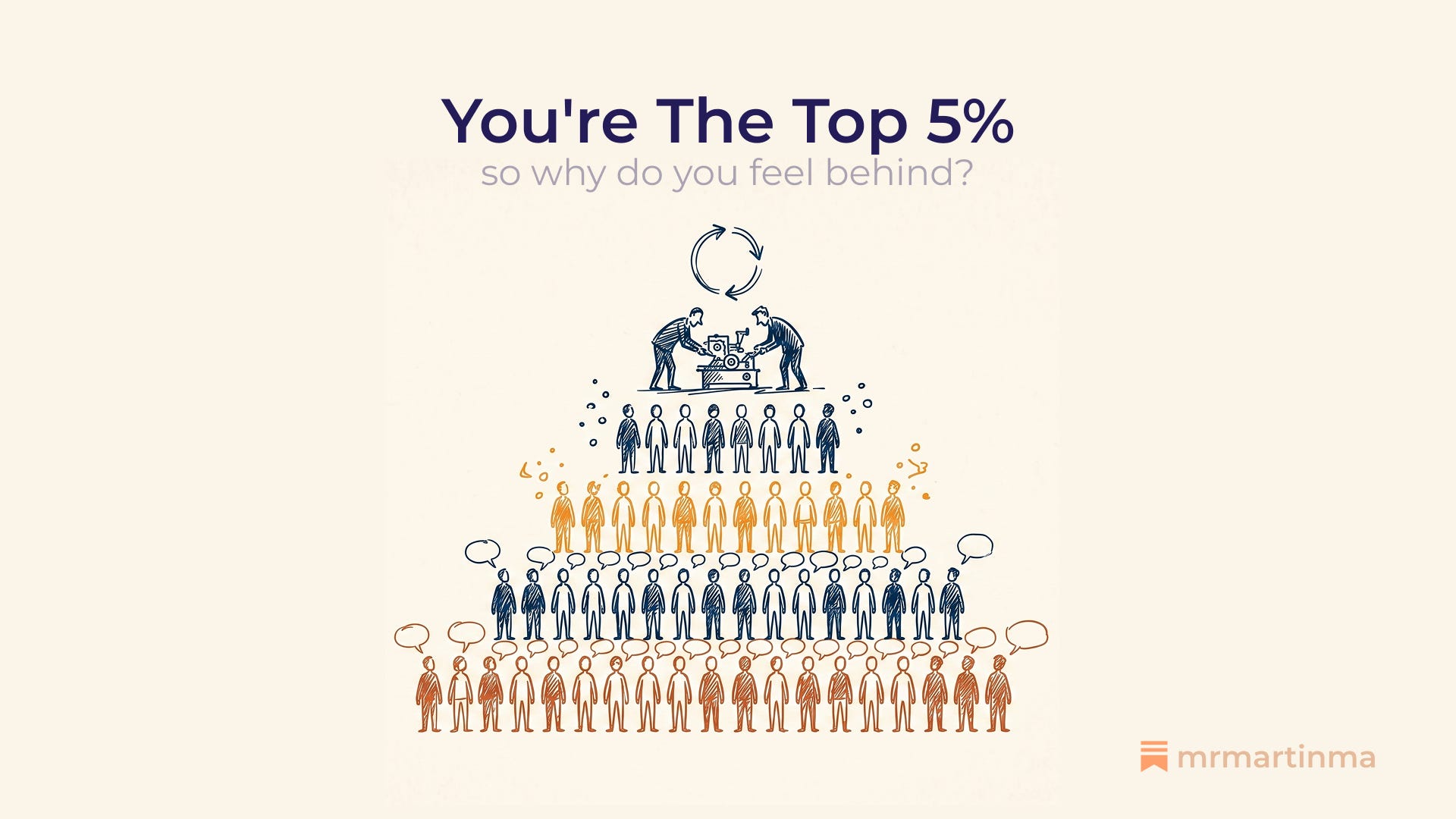
So let me give you the measurement I offer them. If you, or your teams, are driving AI through code, through agents, through loops that run while nobody watches, you are not behind. Measured against everyone who uses AI, that’s the top five percent. The power users. And in this tier, power means what you get done with it.
The feed is not the field
Step out of the timeline and look at what AI actually is for most of the world. It’s a chat box. It drafts an email, summarizes a document, rescues dinner. When OpenAI looked at how people really use ChatGPT, coding turned out to be about four percent of the messages. Drafting email alone was three times bigger. That’s messages, not people, but the picture is hard to miss: the average AI user is asking for recipe tweaks, not Python scripts.
Meanwhile somebody on your platform team is at 11 PM arguing with an agent about a failing test.
Both of those count as “using AI.” They are barely the same activity. And every serious attempt to measure it keeps finding the same shape: a small tier using these tools in a fundamentally different way, and a long tail using them like a smarter search bar.
Call the tier five percent. You know who yours are.
The line is the loop
What separates that tier isn’t intelligence, and it isn’t even code, exactly. The line is whether you build systems AI runs, or ask it questions one at a time. The ninety-five percent chat. The five percent close the loop: hand the model a task, give it a way to check its own work, and let it run. Code is just where that comes most naturally, because tests pass or they don’t, and because code is the tool that can drive every other tool. I made the longer version of this argument in “What the Hell Is Loop Engineering?” The loop is the thing. The syntax is optional. And the reason any of it matters isn’t elegance: a closed loop is a problem that stays solved while you sleep.
I still run a small loop of my own some weekends, not to ship anything, but to keep my questions sharp when my teams show me theirs. And what strikes me every time is how old this pattern actually is. Every office I’ve ever worked in had this person before AI existed. Most of us used a tenth of what Excel could do; somewhere down the hall sat the one who wrote the macros that quietly ran the department. “Power user” has been a word since 1984, when it was mocked as a label for show-offs typing convoluted commands. The mockery aged badly. The pattern didn’t. The power tier was always the tier that scripted, and AI just moved the threshold.
Why being ahead feels like falling behind
Because the reference class is the feed, not the field. The person across from me in that one-on-one isn’t comparing herself to the median AI user rescuing dinner. She’s comparing herself to the loudest demos on her timeline, posted by the other members of the five percent. (On my feed, apparently, nobody’s demo ever fails.) Scientists have it too; Nature ran a poll of researchers this June under the headline “Scientists have a bad case of AI FOMO.” The fear of falling behind is now better documented than the falling behind.
And the feeling genuinely isn’t a measurement. The one careful study I know that put developers on the clock found the ones who felt noticeably faster with AI had actually been slower. The tools have improved since, but the gap between the feeling and the measurement is the part that stays. I bring that up in leadership conversations a lot lately, because half of them now include some version of “are we behind?” My read, after watching this across every team I have: the anxiety is real, widespread, and almost perfectly uncorrelated with who is actually behind.
What the five percent are for
They’re for pointing at the other ninety-five, not for winning the feed.
My favorite example of how crossable that line is sits on a lawyer’s desk at Anthropic. It’s a vintage payphone. Tap it with a coin and it rings; an AI picks up, asks what you need, and connects you to the right attorney for it. A silly object solving an expensive problem: getting a company’s questions to the right lawyer without anyone playing switchboard. The person who built it is one of their lawyers. Not an engineer. Doesn’t code. He made it with an AI coding tool by describing what he wanted, trying what came back, and fixing it until it worked. His own summary is the line I keep repeating to my teams: “I am not the one coding. I’m just very good at troubleshooting.”
If a lawyer can build a phone system, the price of admission is a real problem and the patience to troubleshoot, not a computer science degree. And there is no shortage of problems: when one state government piloted AI tools, nearly half the employees had never opened ChatGPT before. Mostly a backlog of easy wins, waiting to be picked up.
That’s where leaders come in.
Every organization now has its five percent. The waste I worry about isn’t falling behind; it’s letting that tier spend its edge racing each other, or worse, performing adoption for the metrics, while the invoices, the tickets, the weekly reports, the unopened seats sit exactly where they’ve always been. Finding yours takes one question, in a standup or a skip-level: who automated something last month that nobody asked them to automate? Then hand that person one recurring, unglamorous workflow as a real mandate, with time attached, and watch what a closed loop does to it. And when you check on it, measure the one thing the feed never shows: the value it unlocked, not the usage it logged.
Because that’s the bar, and it’s the one to hold your own feeling against too. The feed measures noise: demos, launches, tokens. What matters is the problems you make disappear. That exhausted engineer ran every loop available and still ended the day feeling behind. Wrong scoreboard. Hold your teams to the value bar and the anxiety turns into a roadmap. Hold yourself to it and the feed gets a lot quieter.
So, no. Your best people are not behind, and neither are you for spending your days enabling them instead of typing next to them. They’re rare. Five percent rare, and rare turns valuable the moment it’s aimed at something that matters. The job now is pointing that edge outward, at the ninety-five percent of work nobody on any timeline is demoing.
Here is my question for Monday: do you know who your five percent are, and what problem are they solving with all that power?
#AI #EngineeringLeadership #PowerUsers #AIAdoption #FutureOfWork #Leadership