

What is your favorite thing to do on a Sunday night?
For me, it should be watching the Lakers game. LeBron is likely doing something defying the laws of physics in his 23rd season.
But for years, I wasn’t doing that.
Okay, actually, that’s a lie. I was watching it. But I wasn’t present. I was watching it while stressing over my absolute least favorite thing.
I was staring at a folder in Evernote called _INBOX_PENDING.
If you know GTD, you know this folder. It’s the digital purgatory where you dumped every PDF, every screenshot, and every “important” article from the last week, promising yourself you’d file them “later.”
Well, later is here. And it sucks.
For the last 20+ years, I have been telling myself a massive lie about productivity. The lie is that being “organized” means having a perfect taxonomy. We are told that if we just find the right hierarchy - if we just create the perfect system of nested folders - we will finally feel in control. (for some of us from the Disney mafia, this was very much true with the legacy GoPub systems, I just picked up this context for my personal life.)
So we spend our Sundays acting like librarians. We tag. We color-code. We move files from “Downloads” to “Projects > 2026 > Q1 > Research”.
But let’s stop lying to ourselves.
It feels like work because it’s tedious. It feels like value because it’s orderly. But in reality, we are just rearranging deck chairs on the Titanic. We are spending more time maintaining our “Second Brain” than we are actually using it to think.
Now till AI became a thing, I started to realize that I wasn’t building a knowledge base. I was digging a Digital Graveyard.
Because once a file went into that perfectly organized folder structure... I never opened it again.
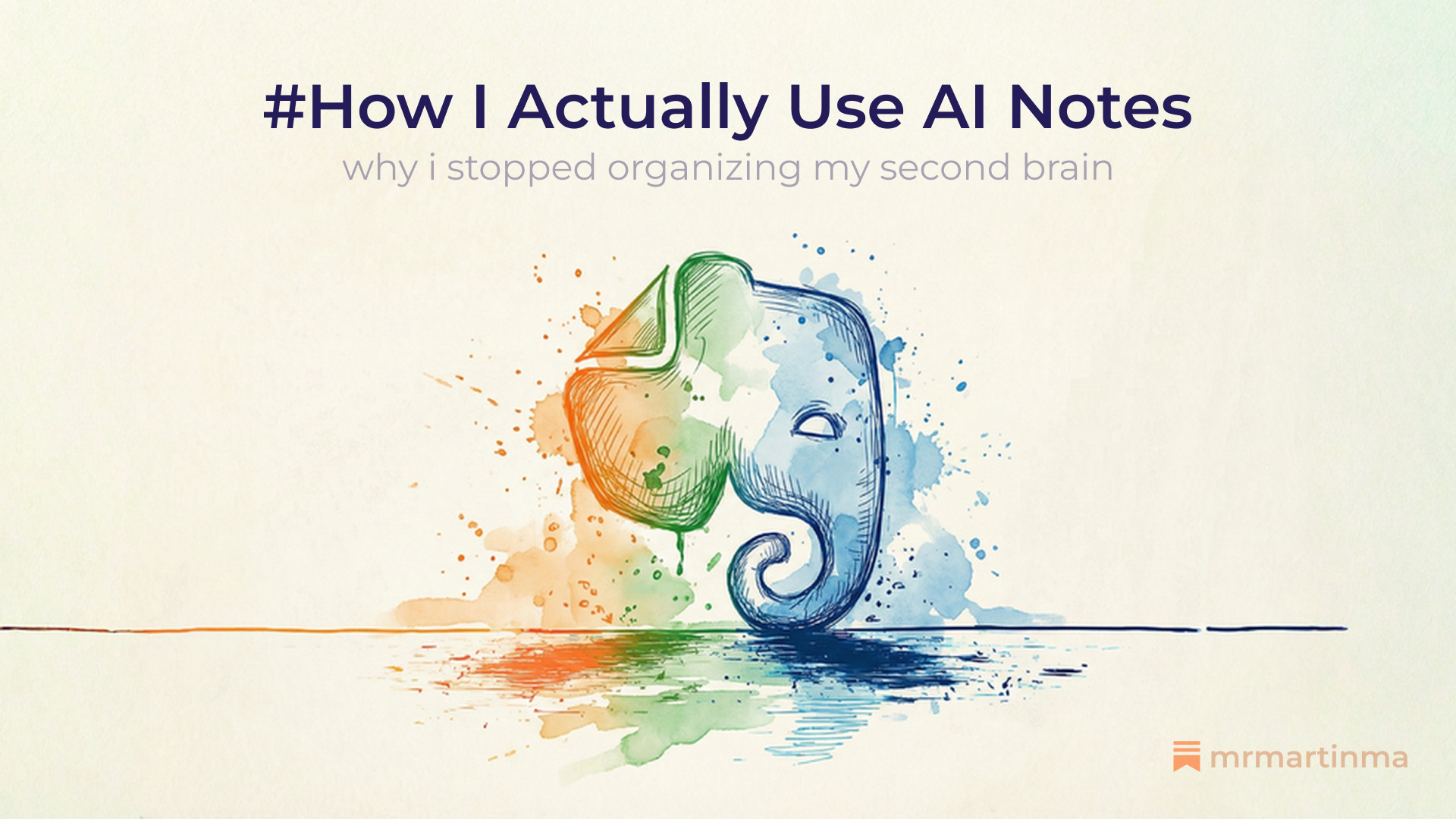
The Death of the Green Elephant
I didn’t come to this realization willingly. I was forced into it.
For 15-ish years, Evernote was my external hard drive. I was a power user. I had thousands of notes, meticulously tagged. I bought the different type of scanners, and digital pencils.
Then, the product changed. It got slow. The features bloated. The “Green Elephant” in the room wasn’t remembering anything anymore; it was just taking up space. And honestly it was probably the most downloaded 1-star app in Apple AppStore for a long time.
But the real breaking point wasn’t the app. It was my own workflow with AI as a new tool.
I found myself doing something ridiculous. I would open an old note in Evernote, hit Cmd+C, switch tabs to ChatGPT, paste it in, and type: “Read this and tell me if I missed anything important”.
Stop and look at that workflow.
I was manually acting as the data pipe between my storage (Evernote) and my compute (LLM). I was the friction.
Evernote didn’t grow, that doesn’t mean I shouldn’t!
It hit me like a ton of bricks: Why isn’t the compute living inside the storage?
Why am I paying rent for a storage unit that makes me do all the heavy lifting?
The “Dumpster” Architecture
That was the moment I stopped acting like a Librarian and started acting like a Data Engineer.
I moved everything to Notion. (Note: I don’t work for them, I just use them. Use whatever works for you).
(And I’m no expert with Notion either - here’s a good YouTube video if you’re interested)
But I didn’t move there to build a pretty dashboard with emojis and inspirational quotes. I moved there to build a Data Lake.
If you’re in data engineering, you know the shift. We stopped building rigid “Data Warehouses” years ago because the schema maintenance was a nightmare. We moved to “Data Lakehouse“ - just dump the raw data in one big pile and structure it later when you query it.
So I applied that to my life. I call it the “Junk Drawer” Protocol.
I stopped tagging.
I stopped filing.
I stopped worrying about “where” things go.
I created one massive database called “The Archive” for all legacy Evernote notes. (The migration sync process was excruciatingly painful, and rate limited after 100 notes.) And I just dump everything there. Plus some simple main pages for home and work.
The friction of capture dropped to zero. But the magic of retrieval went through the roof.
The “Auto-Index” Ritual
Now, when I save a messy meeting notes or a rambling voice memo, I don’t format it.
I just hit a button that asks the AI to do two specific things inside the note:
Connect the Dots: I ask it to “extract the context and connect it to previous notes on this topic.” It reads the note and links it to the 3 previous related notes about that project. It builds the breadcrumbs for me.
The “Search Beacon”: I ask it to generate a Key Takeaways section at the top. This isn’t just for me to read; this summary becomes the high-quality source text for future semantic searches.
I give it a 30-second glance to make sure it didn’t hallucinate. Then I close the tab.
I spend 30 seconds reading instead of 30 minutes filing.
The “Nod”
Now, for my fellow data scientists and engineers reading this - I know what you’re thinking.
“You just described RAG.”
Yes. Exactly.
I just built a personal Retrieval-Augmented Generation pipeline for my life. My messy notes are the proprietary vector embeddings; my question is the prompt.
Instead of searching for keywords (which fails if I search for “budget” but wrote “cost reduction”), I search for concepts.
I ask my Second Brain:
“When is my next doctor appointment? Any specific questions I should last based on my lab results?”
The Notion AI performs a semantic search, retrieves the relevant chunks from five different messy documents, and synthesizes an answer: “Here’s the details for your next appointment. I’d suggest to get the panel blood work done 2 days prior to it, I set a reminder for you in the Home Notes along with the list of questions to ask.”
It finds the truth, even if the keywords don’t match. It gives the LLM “long-term memory” consisting of my own life.
The ROI of Laziness
My Sundays are mine again.
I watch the Lakers game (and yes, they look good in the Sunday whites). My notes stay messy. My “Inbox” is technically overflowing but archived, but my mind is clear.
We have to stop treating “organization” as a virtue. It’s a mechanic. And in the age of AI, it’s a mechanic that should be automated.
Be honest with yourself. When was the last time you actually went back into that perfectly organized ‘Resources’ folder you spent hours curating?
Never.
Because if it takes work to file it, it’s a chore. If it takes work to find it, it’s a graveyard.
I stopped trying to be a Librarian and started building the data assets that only matter to me. My note-taking changed from ‘Just-in-Case’ filing to ‘Just-in-Time’ retrieval.
So, here is my question to you:
How much of your “Second Brain” is actually just a digital graveyard?
(Next Friday, I’ll share how I use this same “lazy” mindset to automate my boring admin work using ‘trash code’ - without writing a single line of Python myself.)
#Leadership #Productivity #AI #Notion #SecondBrain #DataEngineering #FutureOfWork