

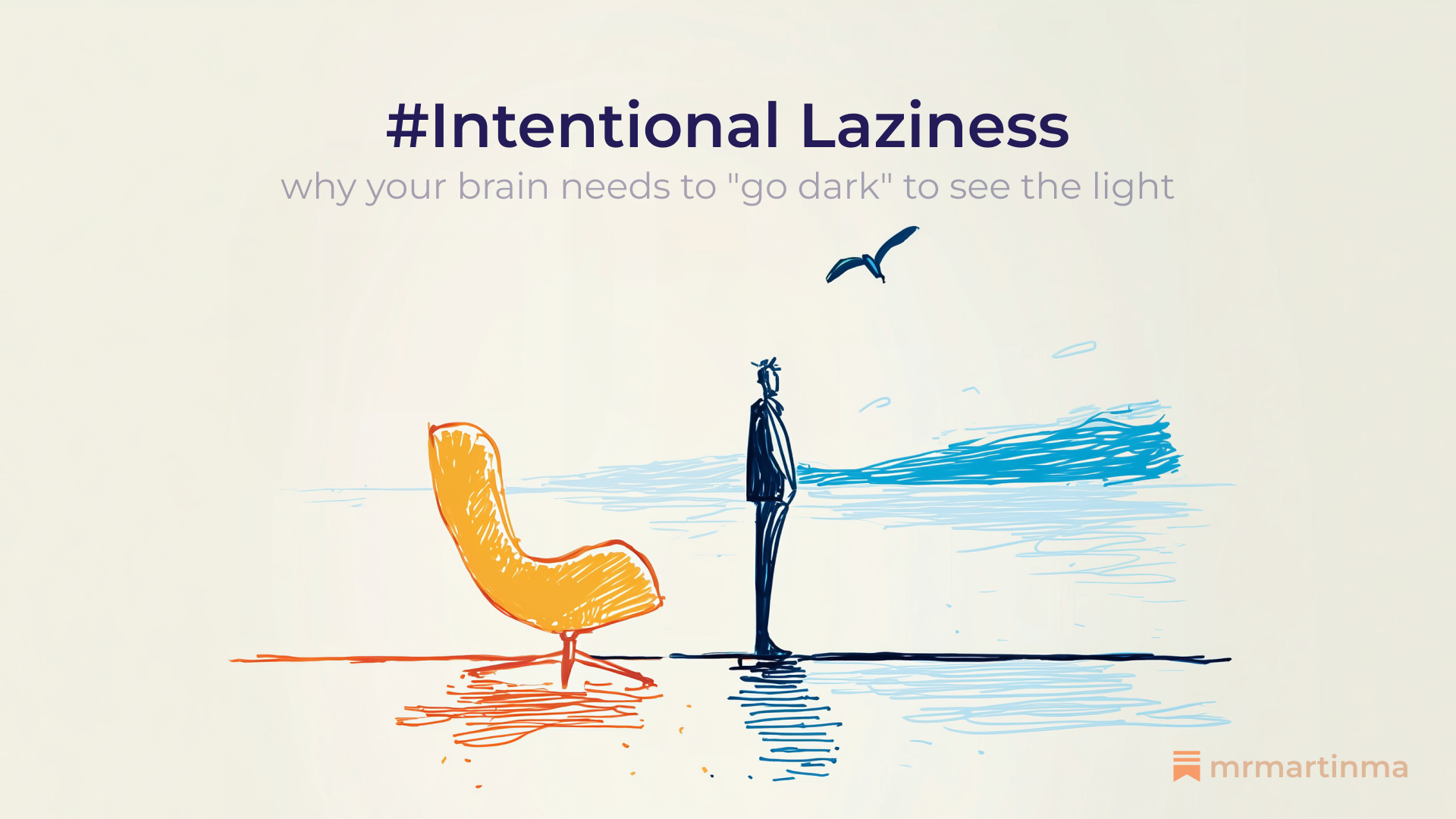
We have been conditioned to believe that “sweat equity” is the only equity.
If you aren’t grinding, you aren’t growing. We treat exhaustion as a badge of honor and silence as a defect. We fill every gap in our calendar with a “sync,” a “touchbase,” or a “quick huddle,” convinced that activity is the proxy for value.
But the economic reality of 2025 contradicts this.
Most of what we call “hard work” today is just anxiety disguised as productivity. It is motion, not progress. It is the frantic treading of water in a sea of low-value tasks.
I’m going to argue that your most productive hour last week wasn’t in a boardroom. It was probably when you were staring at the ceiling, or five miles into a run, thinking about absolutely nothing.
We need to talk about the strategic return on doing nothing.
The Efficiency Paradox
I get it. I really do.
When you are building a career, volume matters. You need reps. You need to prove to the market (and yourself) that you can handle the load. We clear our inboxes because it gives us a dopamine hit of “completion.” We attend back-to-back meetings because visibility feels like job security.
(That said, honestly, it also feels safer to be busy than to be alone with your own thoughts. Silence is terrifying when you don’t know what it might say.)
We operate this way because it worked in a linear economy. If you moved more widgets than the guy next to you, you won.
But we have hit the Efficiency Paradox.
According to 2025 Microsoft telemetry, the average executive is now interrupted every two minutes. We have fragmented our attention spans to the point of structural failure. We have optimized our schedules so perfectly that we have engineered out the very thing we are paid to produce: Judgment.
In an AI world, execution is cheap. AI can answer emails. AI can write reports. AI can “grind” 24/7 without coffee or complaints. If your value proposition is “working hard,” you are competing with zero-marginal-cost software.
You lose that trade every time.
The asset is no longer execution; the asset is insight. And the data shows that insight refuses to enter a busy room.
The Neurobiology of Doing Nothing
To understand why stillness is a competitive advantage, we have to strip away the wellness fluff and look at the hardware.
1. The Lazy Brain is the Innovation Engine
Look, I’m not a neuroscientist. I’m an operator. And my job isn’t just to drive revenue; it’s to protect my team from burning out their engines. Here is how I explain it to my leaders when I see them grinding themselves into dust.
Think of your team’s focused brain - the part that answers emails and crunches numbers - as the “Day Shift.” They are logical, linear, and fast. They are the ones who keep the lights on. But if you force them to work a double shift every single day, the brain don’t just get tired - they get stupid.
When you allow your team to stop focusing - when you encourage them to stare out the window or zone out - you are letting the Day Shift go home. That is the only time the “Night Shift” can clock in.
Scientists call this the Default Mode Network, but as a leader, I view it as the “innovation crew.” This crew wanders the empty office of the brain, finding connections between files that the Day Shift was too busy to notice.
A 2025 study by Shofty et al. confirmed what every experienced manager knows: if you never let the Day Shift leave, the Night Shift never shows up. You get efficiency, sure. But you lose the breakthrough. And eventually, you lose the team.
2. The Runner’s High
This explains why your best ideas rarely happen at your desk.
Runners and endurance athletes know this phenomenon well. There is a reason your strategy deck finally “clicked” at Mile 5, when your legs were heavy and your lungs were burning. It’s a mechanism called Transient Hypofrontality.
Running is metabolically expensive. To save energy for motor function, the brain temporarily down-regulates the Prefrontal Cortex. The Prefrontal Cortex is your inner CEO - it’s the voice of logic, planning, and crippling self-doubt.
When you run hard enough, you effectively take the CEO offline.
With the “Boss” out of the building, the rigid filters disappear. Weird ideas are allowed to mingle. The constraints of “that will never work” fade away, and pure association takes over. You aren’t running to get fit. You are running to induce a state of temporary cognitive madness where innovation becomes possible.
(If you run with a podcast at 2x speed, you are cheating yourself. You are keeping the Day Shift on the clock. Unplug. Let the boredom hurt a little.)
3. The Sheldon Cooper Busboy Method
You don’t need a lab coat to see this in action. You just need to watch The Big Bang Theory.
In the episode “The Einstein Approximation,” genius physicist Sheldon Cooper hits a cognitive wall. He is trying to figure out why electrons behave as if they have no mass when moving through graphene. He tries everything the “Hustle Culture” playbook suggests: skipping sleep, staring at whiteboards, even playing in a ball pit.
Nothing works. The “Day Shift” is burned out.
He realizes his conscious focus is the bottleneck. To fix it, he takes a menial job as a busboy at the Cheesecake Factory. He needs a task that is physically repetitive but mentally undemanding - wiping tables, stacking plates - to occupy his hands so his “back-burner brain” (the DMN) is free to run simulations.
The breakthrough happens in a cinematic moment of clumsiness. While clearing a table, he drops a tray of dishes. The shattering sound - or perhaps the scattered pattern of the mess - triggers the epiphany. He realizes the electrons move in a wave pattern. He shouts “I’ve done it!” and walks out on the job immediately.
He didn’t solve the Nobel-level physics problem by thinking harder. He solved it by doing the dishes.
Sometimes, the most strategic thing you can do for your Q1 strategy is to perform a menial task that lets your subconscious take the wheel.
A Simple Holiday Thought
To be honest, this is just what is going through my mind today.
We spend 11 months chasing speed. We optimize, we hack, we sprint. And maybe, just maybe, this weird liminal space between Christmas and New Year’s is the only time we are actually allowed to catch up on stillness.
I’d love to know what is on your mind today. Are you already plotting your 2026 takeover, or are you happily doing absolutely nothing? (There is no wrong answer!)
However you choose to spend these last few days of the year, I hope you find some peace. You’ve earned the reset.
Wishing you the happiest of holidays and an amazing 2026.
#Leadership #Productivity #MentalHealth #Neuroscience #StrategicLaziness