

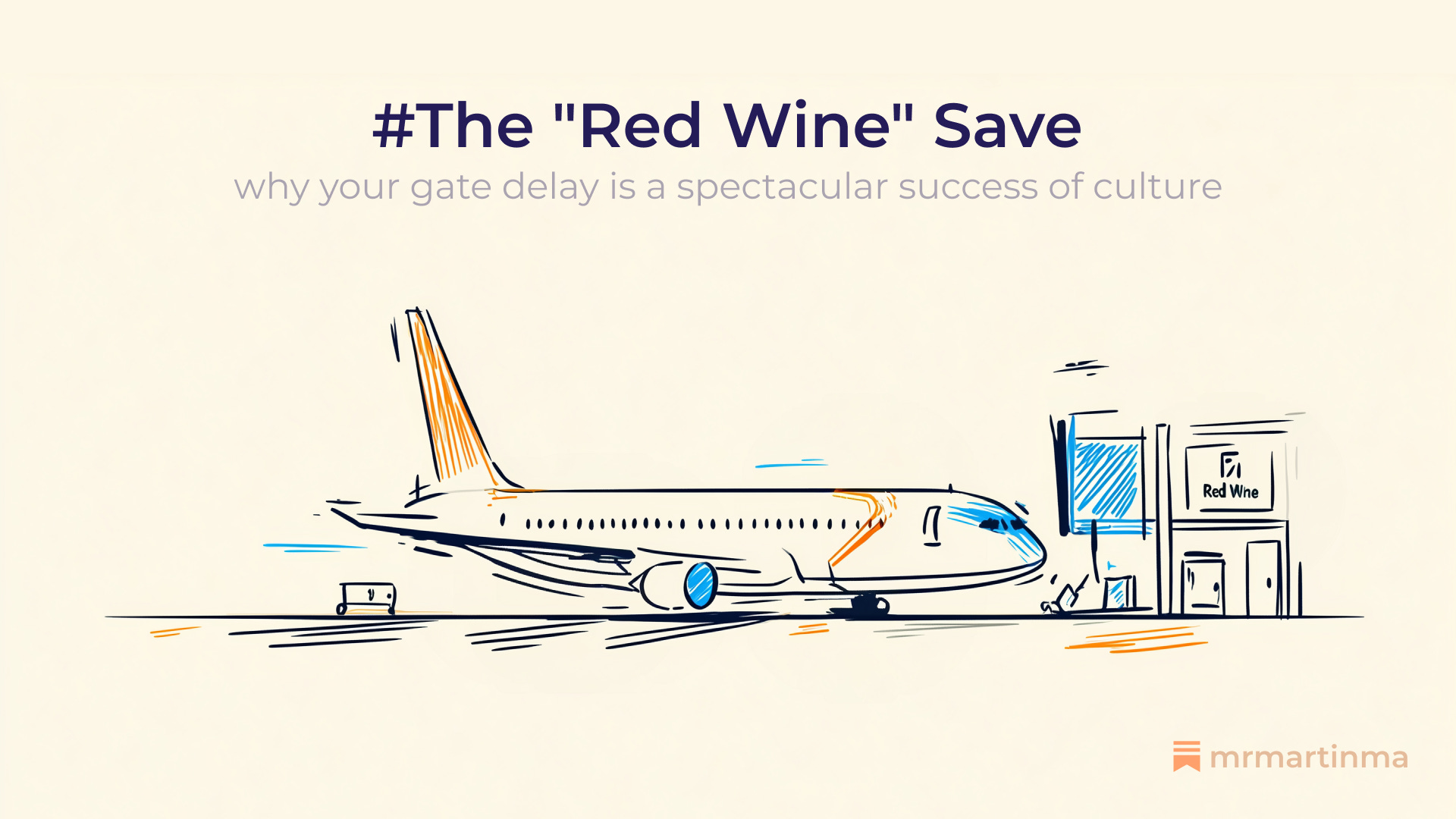
I was flying back home from the holidays last week, and the energy in the cabin was frantic.
You know the vibe. Every overhead bin is stuffed to capacity. The flight attendants look exhausted. We had finally pushed back from the gate, and I was looking at the Flighty app for the potential early arrival to beat the crowd at the immigration line. I’ve flown million+ miles; I have the system down to a science.
Then, the plane stopped. The engines spooled down.
The Captain’s voice crackled over the intercom: “Folks, we’ve got a maintenance indication on the panel. We’re going to have to return to the gate to have a mechanic take a look”.
The collective groan was visceral.
My internal monologue kicked in immediately. Even with all my experience, I wasn’t thinking about safety. I was thinking about competence - you know - the CoE culture you have fostered and celebrated.
“Why now?”
“The plane sat at the gate for an hour. Why didn’t they catch this during the turn?”
“This is a failure of planning.”
I looked across the aisle. Sitting across was an off-duty pilot, deadheading back to his home base. He didn’t look annoyed. He didn’t check his watch. He just closed his eyes and leaned back.
“Doesn’t this drive you crazy?” I asked him, motioning to the jetway connecting back to the plane. “We were ten feet from freedom.”
He opened one eye and smiled.
“Not really,” he said. “A delay at the gate is inconvenient. A problem in the air is tragic. If we’re turning back, it means the system is working. It means someone - probably a junior mechanic or a first officer - saw something and wasn’t afraid to stop the show.”
He paused, then added ...
“I’d rather be on the ground wishing I was in the air, than in the air wishing I was on the ground.”
That conversation shifted my entire perspective.
Now, I, for one, look at a gate delay and see a broken process. But if you look closer, you realize that a gate delay is not a failure of planning. It is a spectacular success of culture.
It is a $100M+ machine stopped by a $20 decision - proof that the culture values Stop Work Authority more than the schedule.
The Last Minute Pivot
Most leaders view “last-minute” issues as a symptom of fragility. We ask, “Why didn’t we catch this upstream?”
But in complex, high-stakes environments - whether it’s launching a rocket, deploying code, or flying a jet - the “last minute” isn’t an arbitrary point where luck runs out. It is a functional boundary.
In aviation, the aircraft sits dormant at the gate until the final moments before pushback. It’s only then that the systems are fully energized, pressurized, and handed over to the human operators. That transition creates stress.
The contrarian view is this: “Last minute” catches are the only proof that your safety mechanisms are actually working.
If your team never pulls the emergency brake right before a launch, you don’t have efficiency. You have a ticking bomb.
The Red Wine Save
That conversation sparked an obsession. I wanted to see if this “culture of stopping” was just a nice theory or if it actually played out in the messy reality of the tarmac. So, I did my homework. I started digging through pilot forums and incident reports to see what “pulling the cord” actually looks like.
That is where I found this thread on r/aviation, where a pilot shared a story that perfectly illustrates the cost - and value - of vigilance.
He was performing a pre-flight walkaround in sub-zero temperatures (-20°F). He’s tired, he wants to go home, and the pressure to leave on time is immense. But he notices a long, thick stripe of frozen red liquid across the bottom of the fuselage.
In aviation, red fluid usually means one thing: Skydrol. Hydraulic fluid. The lifeblood of the flight control system.
“Well, [shoot], this looks like the mother of all hydraulic leaks,” he thought.
He makes the call. He delays the flight. Mechanics swarm the plane. They tear off panels, bleed lines, and refill reservoirs to troubleshoot the leak. The passengers are furious. The delay clocks in at over two hours.
The verdict?
It wasn’t hydraulic fluid. It was Merlot.
A flight attendant on the previous leg had poured a leftover bottle of red wine down a galley sink, which discharged overboard via a drain mast. The extreme cold had frozen it to the fuselage instantly.
Now, would it play out this way everywhere? This pilot would be reprimanded. “You delayed a flight for wine? You cost us thousands of dollars for nothing?”
But in a High Reliability Organization (HRO), this was a “Good Catch.”
The delay was the price of verification. The pilot was embodying what organizational theorists Karl Weick and Kathleen Sutcliffe call a “Preoccupation with Failure.” In their HRO framework, this principle demands that you treat any weak signal as a symptom of a catastrophic problem until proven otherwise.
The pilot prioritized investigating the anomaly over guessing the outcome. He didn’t assume the best-case scenario (it’s just a spill); he respected the system enough to assume the worst-case scenario.
He stopped the line because he didn’t know the answer.
And he can.
The Toyota Andon Cord
This brings us back to the most famous concept in manufacturing history. You likely know the story. It’s the Andon Cord.
In the Toyota Production System, the Andon Cord is a physical rope that hangs above the assembly line. If any worker - from the newest hire to the senior manager - sees a defect, they pull the cord.
The entire line stops.
It is expensive. It is disruptive. It is annoying.
But Toyota realized that fixing a defect on the line costs $1. Fixing it after the car is sold costs $1,000 (and your reputation).
In aviation, the “cord” is the logbook entry. When a pilot or mechanic writes up a fault at the gate, they are pulling the cord. They are stopping the massive machinery of the airline schedule because they see something that doesn’t look right.
The “Gate Return” is simply the Andon Cord in action.
For the fellow engineers reading this, you know this concept by a different name: “Shifting Left“. In engineering, we obsess over moving testing earlier in the development lifecycle because fixing a bug in production is 100x more expensive than fixing it in code review. A gate return is the ultimate physical manifestation of Shifting Left. It is the discipline to catch the failure while you are still on the ground (development), rather than dealing with it at 30,000 feet (production).
Leadership Takeaway
Here is the uncomfortable reality I see in many teams. We claim to want “Agile” and “Quality,” but we punish the people who pull the cord.
We create cultures where raising a “last-minute” issue is seen as being “not a team player.” So, people stay silent. They ship the code with the bug. They sign the contract with the bad terms. They launch the product with the flaw.
They normalize the deviance because they are afraid of the delay.
But if you can’t stop the line, you don’t have a process. You just have momentum.
The Andon Cord is the difference between driving the machine and just holding onto the wheel.
Do your teams have the authority - and the psychological safety that Amy Edmondson champions - to halt a product launch or a deal closing 10 minutes before the deadline if they see red fluid on the fuselage?
If they don’t, you aren’t “agile” - you’re just fragile. You are flying on luck, not on process.
So, here is the question:
Who on your team has the power to pull the Andon Cord? And when was the last time you thanked them for doing it?
I’d love to hear your thoughts.
#Leadership #AviationSafety #HighReliabilityOrganizations #Culture #StopWorkAuthority #Management #AndonCord #Resilience