

A friend of mine leads an engineering org. We go back several years. We talk most months, sometimes over coffee when we’re in the same city, usually just a phone call where we get into what’s actually going on. No agenda, just real talk. I look forward to those conversations. This person has a gear that most people don’t. The kind of leader who gets excited about a messy system problem the way other people get excited about vacation plans.
Last month, something was off. They showed up. Gave updates. Said the right things. But the updates were shorter than usual. Flatter. More “everything’s fine” than anything real. The kind of answers you give when you’re performing normalcy instead of living it. I noticed because I know this person. They don’t do surface-level. And the thing that was missing wasn’t energy or enthusiasm. It was the thing underneath. The quiet drive that used to make them lean into a problem before anyone asked them to. That was gone. Not replaced by frustration. Just... quieter.
I didn’t push it on the call. But afterward, I sat with it. Because I’ve seen that look before. In other people I’ve worked with. In myself.
And when I started paying attention, I saw it everywhere.
It’s not just them
You know how you can tell? Not from surveys. From the way people talk about work now versus two years ago. The engineer who used to send you articles about some new tool they were excited about now just asks if you’ve heard about the latest round of layoffs. The person who used to stay late because they were chasing a problem now stays late because they’re afraid to be seen leaving. The team Slack that used to have side threads about interesting architectural debates now just has standups and status updates. Nobody’s complaining. That’s what makes it hard to spot. They’re not angry, they’re not fighting. They just got quieter. And when you ask how things are going, you get “fine.” A lot of “fine.”
And it’s not just ICs. Every engineering leader I talk to says some version of the same thing. The stress is worse than it’s ever been, and the people they’re supposed to carry are harder to reach.
This isn’t a motivation problem. It’s not about hustle, or mindset, or another team offsite with a keynote and a trust fall. Something is happening to the internal mechanism that makes people want to engage at all.
Every furnace has one
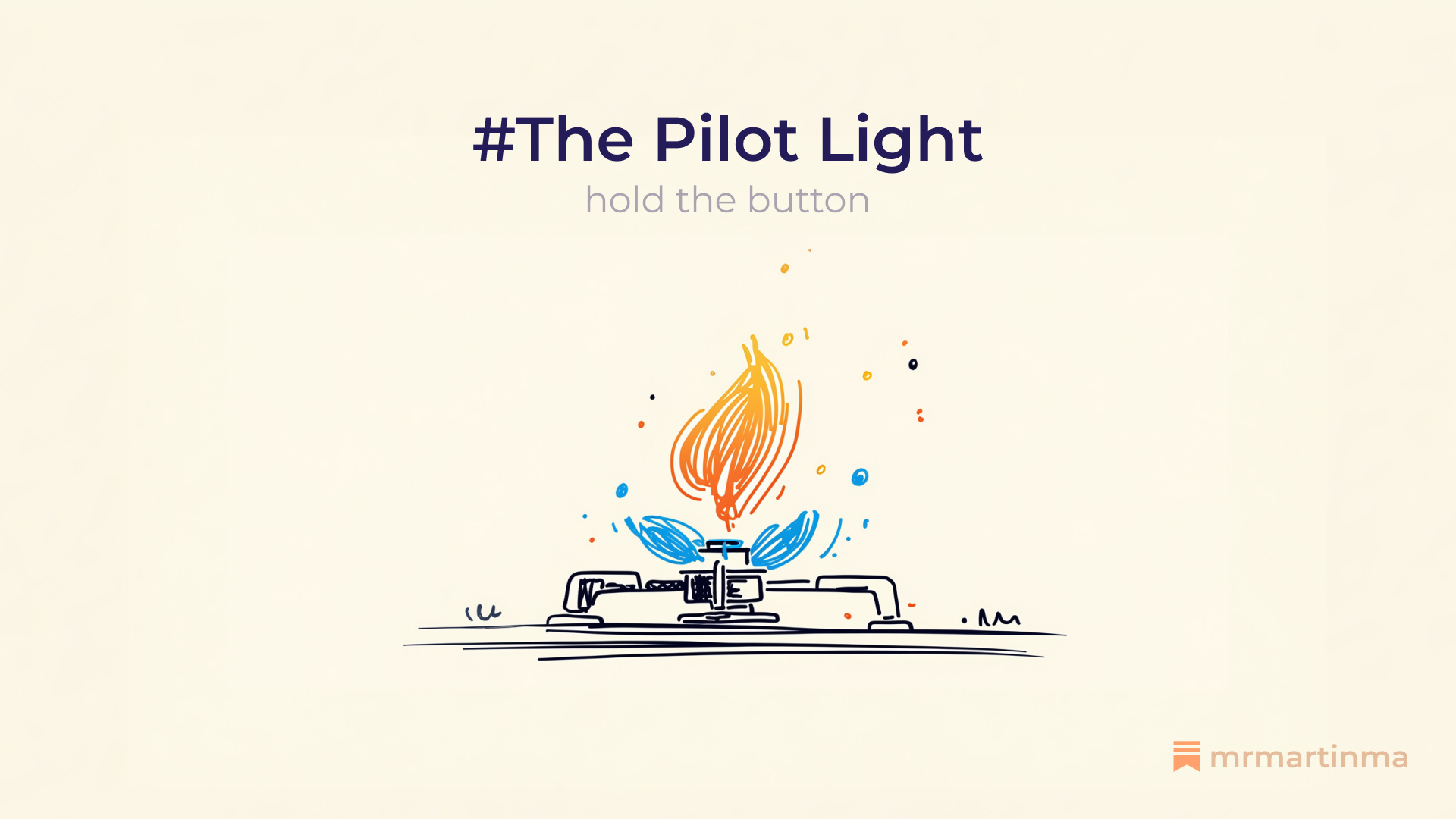
If you’ve ever looked inside a gas furnace, there’s a small flame that never goes out. It doesn’t heat the house. Too small for that. Its only job is to be ready. When the furnace calls for heat, that small flame ignites the main burner. Without it, nothing fires.
That’s a pilot light. (And if you’re an engineer, you already know — we borrowed this exact idea for disaster recovery. Keep the minimum alive so the whole system can fire back up when it needs to. Same principle.)
Drive works the same way. It’s not the big performance — the product launch, the promotion push, the all-hands presentation. It’s the quiet thing underneath that makes you lean in instead of coast. The reason you chase a problem before it’s assigned to you.
Here’s what makes a pilot light interesting: inside the assembly, there’s a small device that sits directly in the flame. It converts the heat into a tiny electrical current. Just enough to hold open the valve that supplies gas. The flame literally sustains itself. No external power needed. As long as it’s burning, the fuel keeps flowing.
But if the flame dips too low, that device cools, the valve closes, and all fuel stops. Not just the pilot light. Everything downstream goes dark.
That’s how drive works. Self-sustaining when it’s lit. And when it dims past a certain point, everything shuts off with it. Energy. Creativity. Ambition. Care. Gone.
What’s blowing on the flame
Three things are dimming the pilot light right now, and none of them are your fault.
The work changed shape. Engineers who used to build for hours straight now spend their days reviewing AI output across half a dozen tasks. The part of work that used to light people up (the building) got quieter. A recent study in Nature found that passively relying on AI reduces your confidence in your own abilities, your sense of ownership over the work, and your feeling that the work means something. And those effects stick around even after you go back to doing things manually.
Effort stopped connecting to meaning. You ship more, but it registers less. You close more tickets, review more PRs, ship more features, move more cards across the board. The link between “I worked hard” and “that mattered” stretched thin. Harvard research on nearly 12,000 diary entries found that nothing fuels motivation more than making progress in meaningful work. When progress stops feeling meaningful, the flame has nothing to burn.
The flame became invisible. Working alongside AI, often alone, often remote. The person who used to notice your energy was off is now a Slack status. When nobody sees the flame, it’s easy to forget it’s there.
You can’t change any of that. The tools shifted. The market moved. The office emptied. But you can adjust. And that’s where the real skill lives.
What you CAN adjust
You can’t control that AI writes a growing share of production code. You can control which problems you personally engage with. Find one thing this week where your judgment (not a model’s) made the difference. The architecture call before something broke. The question nobody else thought to ask. The decision that needed ten years of watching systems fail. That work feeds the flame.
You can’t control that remote work isolated everyone. You can control whether you see people. Not their output. Them. The person whose light is low — your first instinct might be a performance conversation. Sometimes, they just need someone to notice. Be that person for someone this week. And let someone be that for you.
You can’t always control whether the quarterly project lands perfectly, on time, checking every box. You can control whether your team felt progress today. One small win. One moment where someone’s work moved something forward and they knew it. Not a big win. A real one.
You can’t control the pace. You can control whether you gave yourself room to breathe. A pilot light needs oxygen. Smother it and the flame goes out. Sometimes protecting the flame means stepping back. Not quitting. Making room for the fire to find air.
Your flame too
The hardest version of this: your light is low, and you’re the one everyone looks to for heat.
The people supporting the team often carry more stress than the team itself. The hand cupping the flame is shaking.
You adjust the same way. One task. One person. One win. One breath. One day at a time. Your pilot light doesn’t need to be roaring. That small device inside the assembly doesn’t need a bonfire. It needs contact with the flame. As long as there’s heat, the valve stays open. Low is okay. Low is still lit.
And some flames fluctuate because of things that have nothing to do with work. Things you can’t change. Things you adjust around, not through. The flame doesn’t know why it’s being tested. It stays lit anyway.
Hold the button
I talked to my friend again this week. The flame didn’t go out. It got low. What brought it back wasn’t a motivational talk or a new strategy. It was one project that actually needed their judgment. One conversation where someone saw them, not their metrics. One small decision they got to make on their own. One week where progress felt real.
To relight a pilot light, you hold the button down for about thirty seconds. Not long. But you have to hold it. Steady. Deliberate. Until the heat builds back up and the system can sustain itself again.
Drive works the same way. You don’t wait to feel it. You hold the button.
So here is my question to you: what’s one adjustment you can make this week to protect the flame? Yours, or someone else’s.
#Leadership #EngineeringManagement #AI #Motivation #Resilience #TechCareers #FutureOfWork #PilotLight