

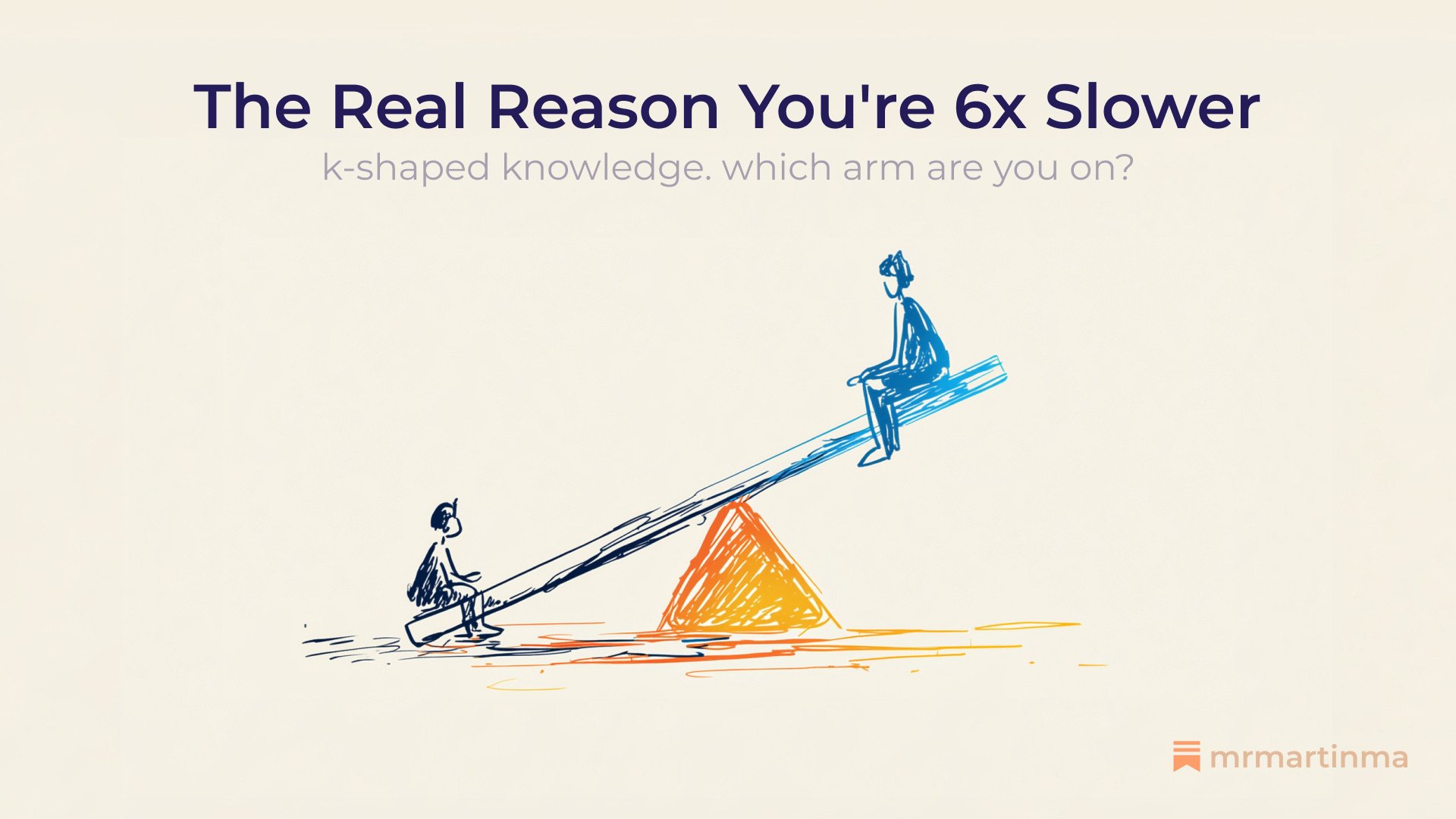
You’ve heard of the haves and the have-nots. It used to be about money.
The top 10% of American households own 67% of the wealth. The bottom 50% own 2.5%. We call it the K-shaped economy. Two populations, same starting point, opposite trajectories. Wealth compounds. Capital makes capital. And the gap accelerates.
Now imagine that same K-shape. But instead of money, it’s what you know. How you work. Whether you’ve figured out how to think alongside AI or whether you’re still doing everything the way you did three years ago.
That K is already here. And most people are on it without realizing which arm they’re on.
The New Haves and Have-Nots
OpenAI’s latest enterprise data tells a story most leaders haven’t internalized yet. Workers at the 95th percentile of AI adoption send six times as many messages as the median employee. Same company. Same tools. Same license.
For coding tasks, it’s 17x. For data analysis, 16x.
This isn’t a gap between companies. It’s a gap between the people sitting next to each other. And it compounds the exact same way.
The question I get asked more than any other: “How do I get started with AI?” From team members. From people I mentor. From new hires who feel behind on day one. What they’re really asking: is the gap already too wide to close?
It hasn’t. But the math is about to get a lot harder. Because this gap compounds. In both directions.
The AI Haves
I remember the exact moment it clicked for me.
I was working on a strategy one-pager. The kind I used to spend a full afternoon writing, staring at a blank document, deleting half of it, starting over. This time I opened an AI tool, spoke my rough thinking out loud, and had structured text back in three minutes. I pasted it into Claude, asked it to challenge my reasoning. Spoke my response to the pushback. Three rounds. Fifteen minutes. A draft that would have taken four hours.
That was week one. Saved some time. Felt like a nice trick.
But here’s what happened over the next few months. I started building prompts for the work that repeated. Meeting prep. First-pass research. Competitive analysis. Over 80% of AI users report saving at least an hour every day. I was saving more than that.
The real shift wasn’t the time savings. It was what we did with the time.
By month three, I stopped using AI to produce and started using it to think. Pressure-testing a product strategy I wasn’t sure about. Exploring edge cases I’d normally skip. Prepping for the hard conversation I’d been putting off. The time savings became capability savings. I wasn’t just faster. I was attempting things I wouldn’t have tried before.
By month six, the question changed entirely. It stopped being “should I use AI for this?” and became “how does AI change what’s possible here?”
75% of leaders and managers are already at this stage. The AI haves didn’t begin with more talent. They began with a first experiment. And compound interest did the rest.
The AI Have-Nots
The other arm of the K doesn’t look like failure. That’s what makes it dangerous. It looks like Tuesday.
You come in. You do your work. Same quality you’ve always delivered. But the person across the hall finished the same deliverable in a third of the time and spent the rest of their morning prototyping something new.
That’s the time trap. Without AI, a task that takes you three hours takes a colleague 45 minutes. You’re spending your entire day on execution. They’re already on the next problem. And the next one. And the next one.
Then comes the learning trap. Because your day is full, you never learn the tools. And because you never learn the tools, you miss what the AI haves discover every week. You’re not behind by one capability. You’re behind by a compounding series of capabilities you don’t even know exist.
I’ve seen this in my own teams. Good people. Same tools. But the ones who didn’t engage didn’t realize the baseline had moved until the gap was visible to everyone in the room. Not a talent problem. A compounding problem.
40% of American workers are completely disengaged from AI. No usage, no interest. 45% of non-users believe AI can’t help their work. One in five hasn’t even heard it’s being used at work.
The confidence trap might be the worst one. The longer you wait, the more intimidating it feels. Starting today feels harder than starting a year ago, even though the tools are easier to use.
Compound erosion doesn’t send a warning. It’s silent. You don’t feel the gap forming. You just wake up one morning and realize you can’t see across it anymore.
If You’re Just Starting Your Career — This Part Is for You
If you just graduated, or you’re in your first or second job, or you’re still figuring out what your field even looks like — there’s a version of the K that hits different.
The numbers are real:
Entry-level jobs are down 13% in AI-exposed occupations (Stanford)
UK tech graduate roles dropped 46% in a single year
66% of enterprises are reducing junior hiring because of AI
38% of engineering leaders say AI has reduced direct mentoring of juniors
The grunt work that used to build expertise — code reviews, financial models, research summaries — is the first work AI replaces. The career ladder isn’t harder to climb. The bottom rungs are disappearing.
Here’s the deeper problem: without domain expertise, you can’t give AI meaningful direction. Without a point of view on what “good” looks like, AI is just a fancy autocomplete. You get output. You can’t evaluate it.
But here’s what the research actually says. And it surprised me.
AI doesn’t help experts the most. It helps beginners the most.
Brynjolfsson’s study: 35% productivity improvement for novice workers. Almost nothing for experienced ones.
The HBS/BCG “Jagged Frontier” study: below-average performers improved 43% with AI. Top performers? Only 17%.
Junior developers build skills 2-3x faster when they use AI as a tutor, not a code generator.
Your disadvantage — no point of view yet — is actually your advantage. No bad habits to unlearn. No “but I’ve always done it this way.” AI can compress the journey from “I don’t know this field” to “I have a point of view” from years to months.
Only if you use it to build judgment, not just generate output. Here’s how:
Ask why, not just what. Don’t accept AI’s answer. Ask it to explain its reasoning. Ask for the counterargument. The act of evaluating AI’s thinking builds yours.
Catch the mistakes. The moment you spot where AI got it wrong, you’re building domain expertise. Every correction sharpens your point of view.
Reinvest the time. When AI handles the grunt work in 20 minutes instead of three hours, don’t fill those hours with more grunt work. Study the domain. Learn why things work, not just what they produce.
That first real experiment, the one where you stop watching from the sideline and actually engage — is the first deposit in your compound interest account.
The Question Behind the Question
We spent the last three years debating whether AI would take jobs. The better question was always which K it would put you on.
So here is my question to you: where are you on the K right now?
Are you compounding? Or are you standing still while the baseline moves under your feet?
And if you’re just starting your career: are you using AI to generate output? Or are you using it to build a point of view?
Because the K doesn’t close on its own. It only compounds.
#Leadership #AI #FutureOfWork #KnowledgeEconomy #CareerGrowth