

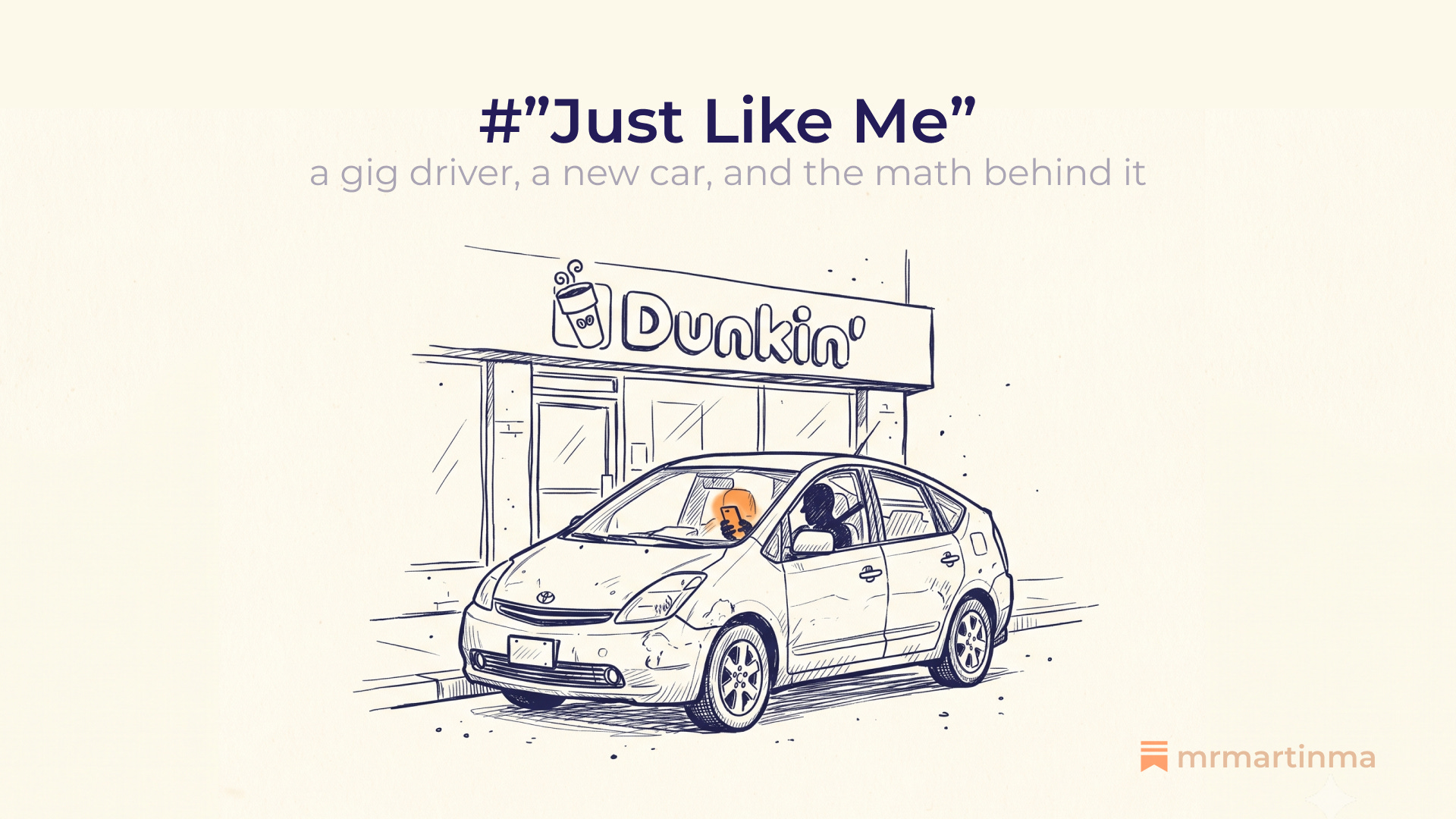
There’s a guy at my Dunkin’ who’s got the morning figured out better than I do.
Same spot every day, closest to the counter, first to grab the app orders the second they’re up. While the rest of us are still at the kiosk deciding between a medium and a large, he’s already got the bag and pulled out of the lot. I’ve watched him for months. The man runs a system.
For as long as I can remember, he drove a beaten-up Toyota that had earned its retirement. Dents. A bumper attached by intention more than hardware. He was busy, working, doing fine.
Then a few weeks ago the old Toyota was gone, and a brand-new one sat in his spot.
“New car?”
“Yeah. Finally.”
“Honestly, I had you figured for a used-car guy. Just like me.“
He laughed. “Everybody says that.”
I meant it as a compliment, which is the part I keep coming back to. I’m a numbers guy, and naturally a used-car guy. Hand me his situation and I’d open a spreadsheet before I opened the car door. Buy new? Never. You let the first owner eat the depreciation and you buy the three-year-old version of the same car. Lowest total cost of ownership. That’s the move. I was sure he’d see it the way I do.
“You know how many miles I put on this?” he said. “Two hundred a day, some days. Call it thirty, forty thousand a year. A used one’s already half gone. I buy new, run it into the ground, don’t think about it in between.”
“Still,” I said. “The second you drive it off the lot...”
“You only lose that money if you sell. I’m not selling. I’m driving this one till it dies.”
He’d already walked to the end of my argument and come back. Then he said the part my spreadsheet didn’t have a line for.
“I can’t be thinking about the car. Every morning I’m wondering if it’ll start is a morning I’m not working the good orders. The day it’s in the shop is a day I earn nothing. I bought new so I’d stop thinking about the car and think about the work.”
He wasn’t buying comfort. He was protecting his attention, which is the thing that actually earns him money. The new car wasn’t a cost he was overpaying. It was the cheapest way to keep his head on the work that pays.
I drove home thinking about how fast I’d filed his decision under “mistake.”
It’s easy to call a decision reckless when you’ll never have to live with it.
Certainty isn’t context
I wasn’t unsure. I didn’t think maybe he was wrong. I was certain, in about four seconds, standing at a counter holding a coffee. The certainty felt exactly like being right. It had nothing to do with whether I actually knew anything.
He had context I didn’t have. A couple hundred miles a day. No cushion. A car that was the floor he stood on all day. None of it was on my spreadsheet, and my spreadsheet was the whole basis for being sure. My math wasn’t even the right math. I’d added up what the car would cost. He’d added up what the old one was already costing him.
Every morning it might not start, every day in the shop, every hour his head was under the hood instead of in the work. Once you count that, the expensive car was the cheaper one. The things I’d waved off as soft were his time and his focus and the relief of not starting every day in a hole. None of it sat outside the numbers. It was the most valuable number on the page, and I’d left it off.
We’re trained to be sure
I do this at work more than I’d like to admit. And I don’t think it’s only me.
We’re paid to make the call.
To look at a situation, reach a conclusion, and move. We get good at it, and being good at it starts to feel like being right. Nobody gets promoted for saying “let me sit with that until I understand it.” So we learn to be fast, and we learn to be sure, and we quietly stop noticing that fast and sure were never the same thing as informed. It’s the four-second certainties that cost the most. The calls you never agonized over, never went back to check, because being sure felt like the work was done.
TCO was never just the cost
And we’re sure so easily because we judge with the numbers we happen to have. The numbers we have measure cost. They almost never measure return.
We love total cost of ownership. On paper it’s something like a vendor contract: the license fee, the seat price, the number on the quote. We pick the cheaper option, feel disciplined, and move on.
But TCO was never only cost. It’s also the return, and the return includes the hour a day your team loses fighting the cheap tool, whether they end the week sharp or wrung out, where their attention goes when the thing just works versus when it doesn’t. All of that gets filed under soft. It’s actually the part that decides whether the thing was worth it. It just doesn’t fit in a cell, so we leave it off the page, the same way I left it off the driver’s.
Watch how often it shows up. The engineer who wants a week to make a flaky system boring and reliable, when there’s a feature waiting on the roadmap. The team that wants the platform you’ve already decided is overkill. The senior who keeps pushing on a deadline you’re sure is fine.
On my numbers, every one of those is waste. But they’re the ones in the seat. They’re the ones counting the 2 a.m. pages, the rework, the slow bleed of good people who got tired of building on top of something broken. They’re running fuller math than I am. They just can’t always show me the cells, because the most important ones don’t have a column.
What it costs to always be right
None of this means everyone who pushes back is right.
Sometimes the expensive call really is reckless, and part of the job is knowing the difference. Usually the difference is easy to hear: the person running real math can tell you what the cheap option will cost you, not just what they’d rather have instead. The point isn’t to stop deciding. It’s to catch the four-second certainty for what it is, and to spend one more question before overruling the person closest to the work:
Do I have the context here, or just the conclusion?
Am I the one who’ll have to live with this, or only the one judging it?
What are they counting that I’m not?
Because the real cost of getting this wrong isn’t one bad call. Every time you overrule the person in the seat on a number that was only ever half the equation, you teach the people who understand the work best that their context doesn’t count, so they stop bringing it to you.
And slowly you optimize your org into the cheapest, most confident version of itself, run by the people least able to see what your spreadsheet is missing.
He wasn’t just like me. Most people aren’t. And the ones I’m quickest to correct are usually running fuller math than I am.
#Leadership #EngineeringLeadership #EngineeringManagement #DecisionMaking #TotalCostOfOwnership #ROI #Management #TeamCulture