

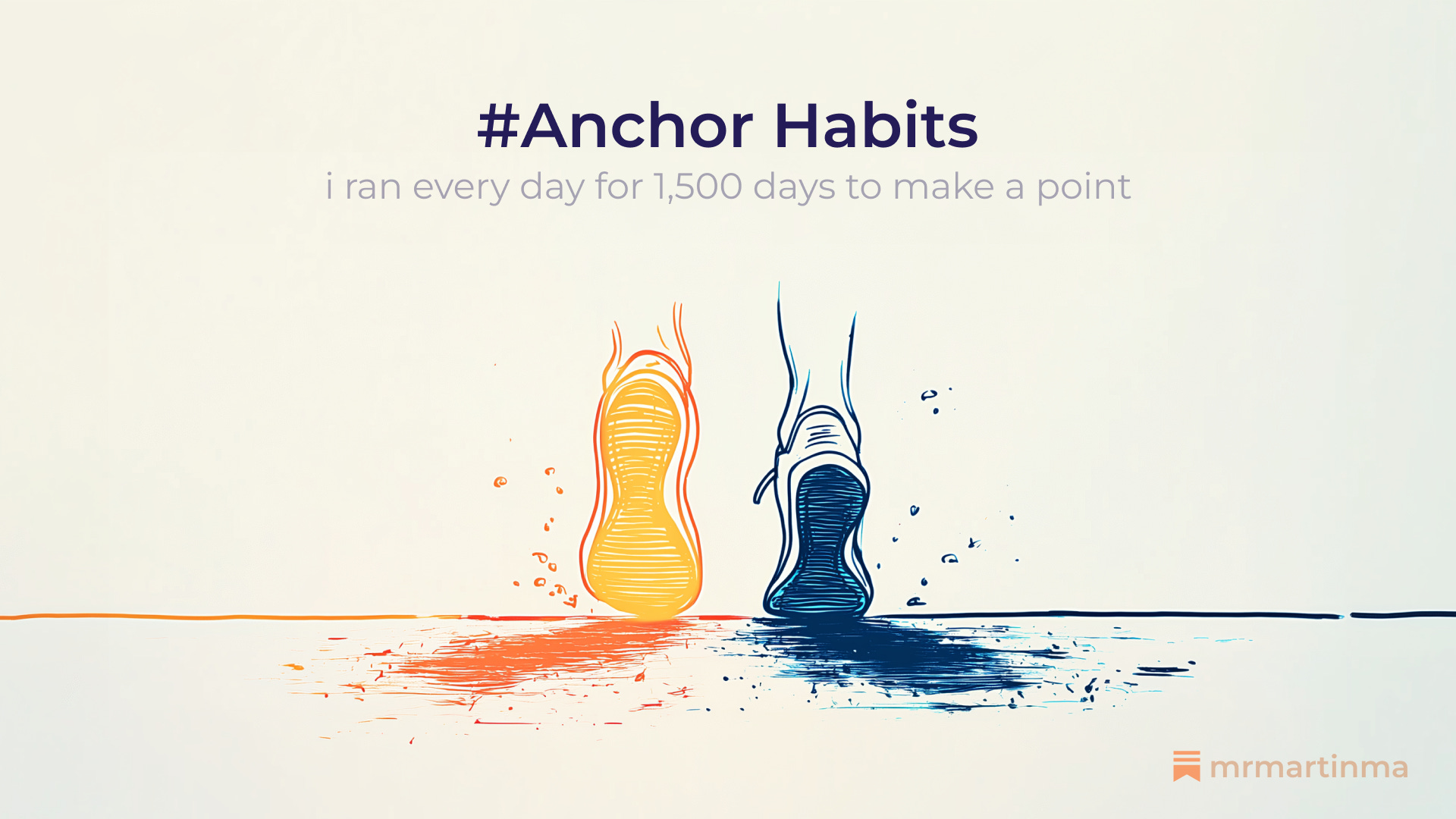
I didn’t run every day for four years to get fit.
I am not a fast runner. I don’t run marathons, and I’m certainly not chasing a podium. By most athletic standards, I am aggressively average.
I ran to prove a point: The New Year’s Resolution is a liar.
For 1,500 consecutive days, I laced up my shoes. It didn’t matter if I had a 5am early morning meeting, a red-eye flight to Tokyo, or a keynote presentation. The run happened first.
People ask me why I kept going after the first year. They assume it was about discipline or health. It wasn’t. It was an engineering stress test. I wanted to see if I could build an anchor point that ignored the calendar entirely.
The “Fresh Start” Trap
Yep, it’s 2026 now. We are approaching the most dangerous day of the year for high performers.
Strava calls it “Quitter’s Day“.
It falls on the second Tuesday of January. It is the statistical cliff where the “New Year, New Me” dopamine wears off, and approximately 80% of resolutions quietly die.
We are conditioned to believe that January 1st is a magical threshold. We treat the calendar like a reset button, assuming that a change in date will trigger a change in character. We believe that the version of us that existed on December 31st, 2025 - tired, inconsistent, perhaps over-indexed on holiday sugar - will be replaced by a disciplined machine the moment the ball drops for 2026.
The data says otherwise.
For a high performer, a “clean slate” isn’t an asset. It’s a liability. It erases the operational data you need to iterate.
The problem isn’t your willpower. It’s your reliance on a “Fresh Start” in the first place.
I ran 1,500 days to prove that you don’t need a New Year. You just need an Anchor.
New Year Resolution vs. Anchor Habits
Yes, I understand the appeal, 100%.
We love the “New Year’s Resolution” because it feels like a pardon. It reduces the cognitive load of our past failures. It offers a cheap dopamine hit of hope without the immediate cost of action. It allows us to dream about the outcome (the six-pack, the promotion, the finished book) without confronting the friction required to get there.
We do this because hope is an emotional resource.
But performance is an engineering problem. And you cannot build a skyscraper on an emotional foundation.
If you want to see the structural failure of emotion-based planning, just wait six weeks.
Visit any Equinox or commercial gym around February 14th. The sea of new faces from January has evaporated. You won’t see the “New Year, New Me” crowd. You will see dust motes dancing in the light shafts over unused treadmills. The motivation burned off. The structure wasn’t there to catch the load.
To survive “Quitter’s Day” in 2026, you have to stop relying on the volatile fuel of motivation and start building with the binary physics of Anchor Habits.
The Physics of Stability
Now, my theory here is - we need to stop talking about “goals” and start talking about system stability.
In civil engineering, an anchor bolt is a heavy-duty fastener used to connect structural and non-structural elements to concrete. Its job is to transfer tension and shear forces from the machine to the foundation. Without it, the machine vibrates itself apart.
In your life, stress is the shear force. The resolution is just paint - it looks good, but it bears no load. To stabilize the system, you need a protocol that transfers the stress into a foundation of discipline.
My Own 1500-Day Story
For me, this concept wasn’t just theory; it was my operational reality.
I didn’t treat running as a “fitness goal” or a hobby. I treated it as a structural necessity - my personal anchor bolt.
I ran every single day for over four years. I closed my Apple Watch rings for 1,500+ consecutive days. It was a perfect, gamified record of consistency.
And then, the glitch happened.
I was restoring my settings to a new iPhone, and a data migration error wiped the streak. In a single digital hiccup, 1,500 days of “proof” vanished. The counter reset to zero.
(I admit, I was mad and stared at the phone in disbelief for ten minutes - I might have even restored the phone five times hoping it was a fixable bug - but the number remained zero).
A “Resolution” mentality would have been devastated. If I were running for the badge, for the dopamine of the streak, or for the “Fresh Start,” I would have quit. The gamification was gone.
But the Anchor Habit revealed the truth immediately. The digital badge disappeared, but the biological adaptation remained. The resting heart rate didn’t reset. The VO2 max didn’t reset. The mental calluses I built running in the rain didn’t dissolve.
The Resolution mentality collapsed. The Anchor Habit held.
This is the difference. A Resolution is fragile; it breaks when the conditions aren’t perfect. An Anchor is anti-fragile; it holds the ship regardless of the storm.
The Lagging Indicator
Most resolutions fail because they target the wrong metric. They focus on the output rather than the input.
Take the most common resolution: “I want to lose 20 pounds.”
This is a structural error. You cannot “do” a weight loss. You can only “do” a behavior. Weight is a Lagging Indicator - it is the delayed result of previous actions. When you focus on the scale, you are trying to drive the car by staring at the rearview mirror.
Whether you are pouring concrete or writing code, the physics are the same.
In engineering, we monitor Leading Indicators - latency, error rates, and saturation - to predict the output. If you optimize the leading indicators, the system stability takes care of itself.
Most people treat health like a subtraction problem: “I just need to eat less.”
It fails because it fights biology. Deprivation triggers a starvation response, your energy tanks, and the “February Crash” becomes inevitable. You are trying to drive the car by staring at the rearview mirror.
The Anchor ignores the scale and focuses entirely on the Leading Indicator - the code you run every day.
Don’t set a goal to “lose 10 pounds.” That’s a wish, not a plan.
Create a plan: “Eat 30g of protein within 30 minutes of waking up.”
This is an executable command. It stabilizes your system and kills cravings at the source. If you get the inputs right, the output takes care of itself.
Anchor Stacking
The Resolution is the ribbon cutting ceremony. The Anchor is the concrete pouring.
The mistake most people make is trying to build the entire skyscraper on Day 1. They commit to a 5am run, a cold plunge, and a meditation hour all at once. That is a recipe for system collapse.
Let’s call it - Anchor Stacking.
You start with one binary action that you actually want to do (or know you can do), and then bolt a tiny habit onto it.
You identify the Anchor (the thing that happens no matter what), and you use it as the trigger for the new habit.
The Anchor: “I run at 5am.” (This is the non-negotiable).
The Stack: “Immediately after I take off my running shoes, I do 10 pushups.”
You have already paid the “activation energy.” You are awake. You are in gear. The friction is zero.
Start with the run. Then add the pushups. Then add the protein.
You don’t need to be a Navy SEAL tomorrow. You just need to show up.
The victory isn’t the marathon. It’s the fact that you laced up your shoes when it was dark outside.
That is the win. Everything else is just mileage.
#Leadership #PersonalDevelopment #SystemsThinking #HighPerformance #Habits