

I read 174 newspapers worth of information today.
You did too.
And tomorrow, we’ll do it again.
And the crazy part is - I couldn’t tell you a single useful fact from any of them.
That’s not laziness. That’s neurology. That’s also the hidden crisis killing your organization’s decision-making velocity. And frankly, it’s why your best people are burning out.
The Real Problem Isn’t That You’re Not Smart Enough
Let me paint a picture you’ll recognize.
There’s a VP of Engineering I know. Brilliant. Built systems at scale. Shipped products that matter. Then AI happened, and suddenly, every single day became an information avalanche.
New model announced? There’s a Slack thread about it.
Competitor launches something? Five urgent emails.
Another hot take on why her entire technology stack is obsolete? It’s trending on Twitter(X).
She tried to keep up. Attended the webinars. Read the reports. Listened to the podcasts. Did the whole thing.
Within three months, her team started noticing something. She became reactive. Not in the “responsive to real crises” way - in the “bouncing between shiny objects” way. Roadmaps changed weekly. Priorities shifted constantly. The one thing her team could count on was that whatever they were building today would probably get deprioritized by Friday.
Her best engineer quietly started looking for another job. Then another. Then three more.
They didn’t leave because the work wasn’t interesting. They left because nobody knew what they were actually building toward.
The VP wasn’t failing. Her brain was drowning.
And here’s what matters: This wasn’t a personal weakness. It was a systems failure.
Her organization gave her infinite information, zero frameworks, and then blamed her for not having magical clarity.
Stop Trying to Remember Everything. Start Building a System.
This is where most people go wrong.
We treat information overload like a personal productivity problem. We download another app. We block another calendar. We set another boundary. We read “Getting Things Done“ for the fourth time.
But the real problem isn’t what we’re doing. It’s how we’re learning.
According to cognitive psychology research pioneered by Frederic Bartlett’s schema theory, your brain is a pattern-matching machine. It’s not built to store facts - it’s built to connect patterns. When you encounter new information, your brain asks a very specific question: “Where does this fit?”
If you don’t have a shelf for it, the information evaporates.
You hear “LLMs are actually terrible at abstract reasoning”. Where does that insight go? If you don’t have a framework for it - if you’ve never sat down and actually built your understanding of what AI can and can’t do - it becomes noise. It joins the other 173 newspapers you forgot about.
But if you’ve done the foundational work - if you’ve actually built your own mental model of AI, grounded in first principles, connected to your business - that same piece of information slots perfectly into place. Suddenly, it’s not noise. It’s signal.
The difference between drowning and thriving isn’t reading more. It’s organizing what you read.
And that’s what a Structured Learning Bookshelf(R) is.
Your Bookshelf is Your Competitive Weapon
Think of it this way:
Your bookshelf = The organized mental models that power your strategic thinking
The books = Information you encounter (news, meetings, customer calls, articles, observations)
The shelves = Categories that organize what matters to your leadership (AI Applications, Customer Strategy, Team Dynamics, Financial Reality, etc.)
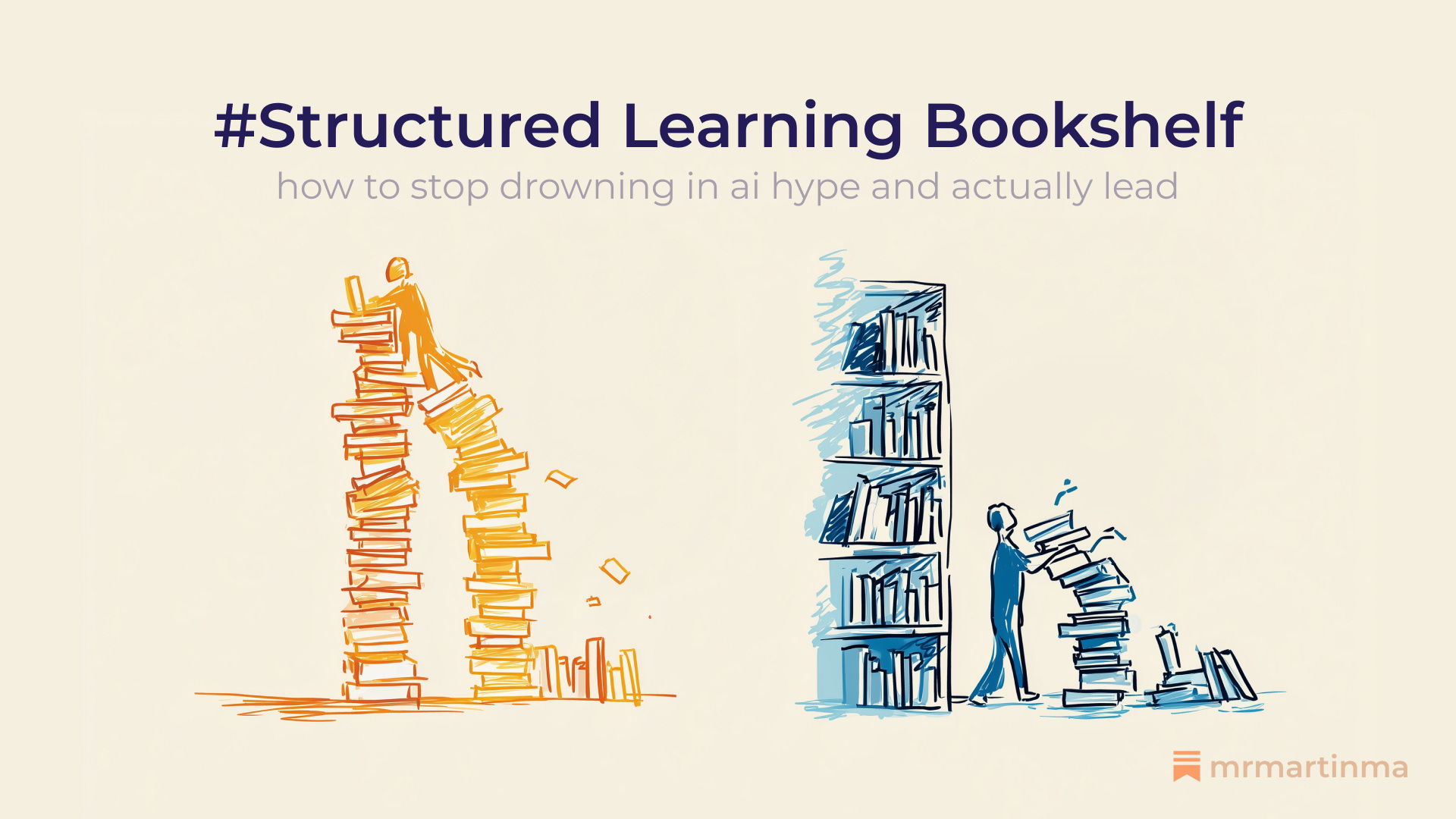
Now for most leaders - They collect books chaotically. Pile them everywhere. Wonder why they can’t find anything.
Then, there’s the strategic leaders - They build shelves first. Then they thoughtfully place books on them.
This sounds simple. It’s deceptively powerful.
Here’s what actually changes: When you have a bookshelf, you stop reacting to the day and start strategizing through it.
Your competitor launches an AI feature? You don’t panic. You have a framework. You know your customer problems. You understand what’s actually possible with AI. You can make a decision in a meeting instead of spending three weeks in chaos.
A new trend emerges? You don’t chase it. You can instantly evaluate whether it fits your strategy or it’s just noise.
The VP’s team isn’t pulling in seventeen different directions. They’re moving in one clear direction, with new information informing that direction, not constantly changing it.
This is the difference between reading 174 newspapers and actually being informed.
The Three Layers of a Bookshelf That Actually Works
Building a useful bookshelf isn’t random. There’s architecture to it, and understanding it is how you go from overwhelmed to clear.
Layer 1: Your Bookshelf Foundation - Schema Theory
Here’s the neuroscience that everyone gets wrong:
Your brain can only understand new information if it fits into a schema - a mental model you already have. When new information arrives that doesn’t fit? Your brain either forces it into the wrong category or discards it entirely.
This is why “AI learning programs” fail so consistently. You’re being asked to absorb information without a framework. Your brain rebels. It feels like drinking from a fire hose because your brain literally cannot process the fire hose.
But when you’ve built your schema first - when you’ve done the hard thinking about what’s fundamentally true in your domain - new information clicks into place.
The practical implication: Don’t build your bookshelf after you’ve learned everything. Build it before you start consuming. The foundation comes first. The books fill in the details.
Layer 2: Your Framework - First Principles Thinking
Here’s where most leaders get stuck, and where the hype game wins.
Your instinct is to copy. What’s everyone else doing with AI? Build that. What’s your competitor’s strategy? Copy it. What’s trending? Jump on it.
That’s not strategy. That’s following.
Real strategic clarity comes from asking a completely different question: What is fundamentally true about my business?
For AI, it might sound like this:
What is an LLM actually doing? Predicting the next word. That’s literally it.
What’s it genuinely good at? Pattern recognition. Summarization. Language tasks.
What does it struggle with? Abstract reasoning. Complex logic. Real-time information.
What does that mean for my team? AI is a lever to eliminate grunt work, not a replacement for thinking.
Once you answer those questions, you’ve built a framework that’s yours. Not someone else’s. Not whatever trend is currently dominating Twitter.
Now when someone panics and says, “We need an AI strategy!” you don’t spiral into a three-week emergency planning session. You consult your framework. You have a POV. You can make a decision.
This is what separates leaders who shape markets from leaders who chase them.
Layer 3: How It All Connects - Systems Thinking
Here’s the final piece that separates growing leaders from senior ones:
Your shelves aren’t isolated. They’re connected.
Your “Customer Problems” shelf connects to your “Business Reality” shelf, which connects to your “Team Capability” shelf, which connects to your “Technology” shelf. When you spot a signal on one shelf, you instantly understand its ripple effects across the entire system.
A customer starts asking for faster data delivery. That’s a signal on your Customer shelf. But you instantly see: What does that mean for your Architecture shelf? Your Team Capability? Your Budget? Your competitive position?
A growing leader sees isolated problems. A senior leader sees a connected system where changes ripple and compound.
This is why some leaders see opportunities others miss. They’re not smarter. They’re just operating from a more integrated mental model.
The Real Prize: Signal vs. Noise
Everything I just described - the framework, the process, the daily discipline—exists for one reason:
To train your brain to distinguish signal from noise.
Leadership is filtering. It’s separating meaningful from meaningless. Urgent from important. Real threats from distractions.
Without a structured learning system, you can’t do this. You’re just reacting to whatever feels loudest.
With a bookshelf? You have a lens.
The Framework That Stops You From Panicking
I use a model developed by Nitin Nohria, former dean of Harvard Business School. You can use it too:
Clarion Calls — True crises demanding full engagement (security breach, product failure). Full stop. These are real. Deal with them.
Whisper Warnings — Weak signals with low urgency, high potential impact (market trends, competitor moves you can barely see). These deserve investigation, not panic.
Siren Songs — Tempting, high-visibility “opportunities” that are actually distractions (competitor announcements, hot trends, everyone-else-is-doing-it moments). These pull you away from strategy. Actively ignore them.
Normal Noise — Daily fluctuations, minor complaints, random events. Monitor. Delegate. Move on.
Without a bookshelf, every event looks equally important. With one? You categorize instantly.
Your First Move: Start This Week
I’m not asking you to overhaul your entire life.
Pick one domain where you need clarity. Maybe it’s AI adoption. Maybe it’s your product strategy. Maybe it’s team dynamics. Pick one.
This week, capture 3-5 insights in that domain. Don’t perfect them. Just capture.
Next week, organize them. Find the core idea. Write one sentence for each.
Do that for four weeks. You’ll have a working bookshelf.
Within a month, I promise something shifts. Decisions come faster. Your POV is clearer. You feel less overwhelmed.
That’s not magic. That’s structured learning with the bookshelf working.
The Real Question
The noise won’t stop. AI will keep evolving. Markets will keep shifting. Competitors will keep moving.
That’s not going to change.
But if your bookshelf is strong - grounded in first principles, organized systematically, integrated into a coherent system - you won’t be overwhelmed by it.
You’ll be informed by it.
So here’s my question:
What’s one domain where you need a clearer framework right now?
Pick it. This week, start building that shelf. Capture the core beliefs. Distill them. Test them against reality.
Don’t wait for perfect clarity. Start messy. Iterate. Build in public.
Because this isn’t about having all the answers anymore. It’s about having the best framework for finding them.
Build your bookshelf. Everything else follows.
#Leadership #LeadershipPrinciples #StructuredLearning #FrameworkThinking #AIEra #TechLeadership #EngineeringLeadership #ProductLeadership #StrategicThinking #DataLeadership