

It’s the Friday after Thanksgiving.
If you’re reading this, the Slack notifications have finally slowed down. The urgent emails have stopped. The “Black Friday” rush - whether you’re in 2026 planning or just managing the Q4 sprint - is momentarily paused.
I’m sitting here, not looking at roadmaps, burn-down charts, or OKRs. I’m thinking about the amazing people who made this year possible.
And as I reflect on the teams that have truly moved the needle, I’ve noticed a persistent glitch in how we talk about high performance.
For years, the standard leadership dogma has been that the holy grail of high-performing teams is “Skin in the Game“. You know the theory: align incentives, give equity, tie bonuses to outcomes, and share the risk. The logic is economically sound - if they lose when we lose, they’ll work harder. If they win when we win, they’ll stay longer.
It’s a transaction.
And for a long time, the industry accepted this as the ceiling of motivation.
But look closer at the projects that actually defied gravity. The ones where the team pulled off the impossible not because they had to, but because they refused to let each other fail.
You’ll realize that “Skin in the Game” is incomplete.
Skin in the game buys you alignment. It buys you compliance. It keeps people from leaving when the stock price dips.
But it doesn’t buy the thing that actually matters in a crisis.
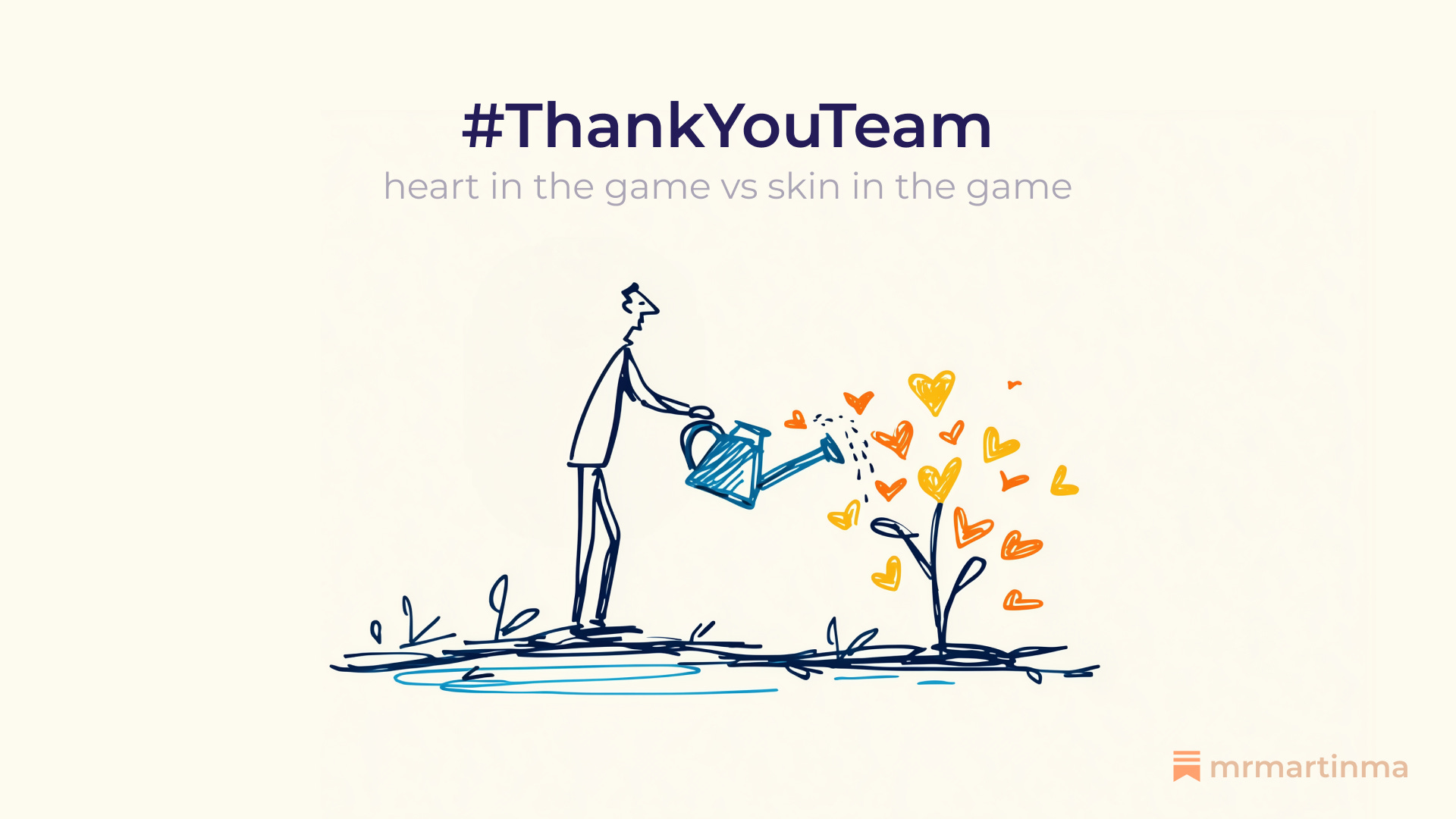
What you really want is Heart in the Game.
Skin in the game is an economic contract. Heart in the game is a psychological covenant. It’s the difference between an employee who stays late to hit a bonus, and one who stays late because they don’t want to let their team down.
And the bridge between the two isn’t more equity. It’s radical, specific appreciation.
The Appreciation Gap
Here is the uncomfortable truth I’ve observed across organizations: Most leaders feel grateful, but they fail to transmit it.
We assume the paycheck communicates value. We assume the quarterly bonus communicates respect. We assume that because we know how important the team is, they must know it too.
But they don’t.
There is a massive signal loss between our intent and their impact. This is the “Appreciation Gap”. To close it, we have to stop treating gratitude like a generic soft skill and start treating it like a high-fidelity signal.
Turning Up the Signal
Most appreciation is just noise. “Great job team” is filler. It’s the leadership equivalent of a generic “Happy Birthday” on a Facebook wall. It doesn’t register.
To get Heart in the Game, you have to change the frequency.
1. It starts with the signal-to-noise ratio.
Lazy appreciation is broad; real appreciation is high-definition. If you tell someone “Thanks for the hard work on the release,” they hear noise. But if you say, “I saw how you refactored that legacy pipeline for the features used in this model to reduce latency by 20ms - that was a craftsman’s choice”, they hear a signal. They know you are paying attention. And attention is the highest form of currency a leader has.
Now to do that - you must know and you must truly care!
2. It moves from the code to the character.
We usually default to high-fiving the launch or the sales number - the outcome. But outcomes often involve luck. Character is a choice. When you praise the resilience someone showed during an outage, or the diplomacy they used in a heated meeting, you aren’t just rewarding a result; you are reinforcing an identity. Telling someone “You are the kind of person who stays calm in a storm and lead the team through uncertainties” is infinitely more sticky than “Good job fixing the bug”.
3. And finally, the ultimate form of thanks isn’t words at all. It’s trust.
The highest compliment you can pay a high performer isn’t a gift card; it’s autonomy. It’s looking at them and saying, “I appreciate you so much that I am going to get out of your way”. When you hand over the keys to a critical project and trust their judgment over your own, that is the moment “Skin in the Game” transforms into “Heart in the Game.”
The Friday Protocol
Since it’s a quiet Friday, let’s not just read about this. Let’s do the work.
We often wait for performance reviews to give feedback. That’s too late. The half-life of gratitude is short.
Here is a simple protocol for today:
The “Unseen Work” Scan: Look for the “glue” - the person documenting the API that everyone hates writing, the senior engineer mentoring the intern when they could be coding, the PM de-escalating the heated Slack thread. Find the work that usually gets zero glory.
The “No-Ask” Note: Send a DM or a text. Right now. But here is the rule: It must be purely gratitude. No “by the way, can you check this?” attached. No “Happy Thanksgiving, are we ready for Monday?” A “naked” thank you.
The Reverse: Acknowledge that as a leader, you are standing on their shoulders, not the other way around.
To My Teams: The Heart Behind the Hustle
This isn’t just theory for me. As I sit here today, I am overwhelmed with gratitude for the teams I have the privilege to lead, and those I’ve worked with in the past.
To the engineers who stayed on the call when the incident dragged into the early morning hours, not because you were told to, but because you wouldn’t leave a teammate to debug alone.
To the data scientists who spent weeks wrestling with messy datasets of 100s of millions users and refusing to torture the data until it confessed, just to ensure our decisions were based on truth, not hope.
To the product managers who shielded the team from chaos so the builders could build.
To the quiet leaders who spoke the hard truth when it would have been easier to stay silent.
I see you. I appreciate the craft you bring to the code, but I appreciate the character you bring to the culture even more. You have taught me that while “skin in the game” builds companies, “heart in the game” builds legacies.
Thank you for your trust, your resilience, and your heart.
#Leadership #Thanksgiving #Gratitude #TeamCulture #HeartInTheGame #Management #HumanLeadership