

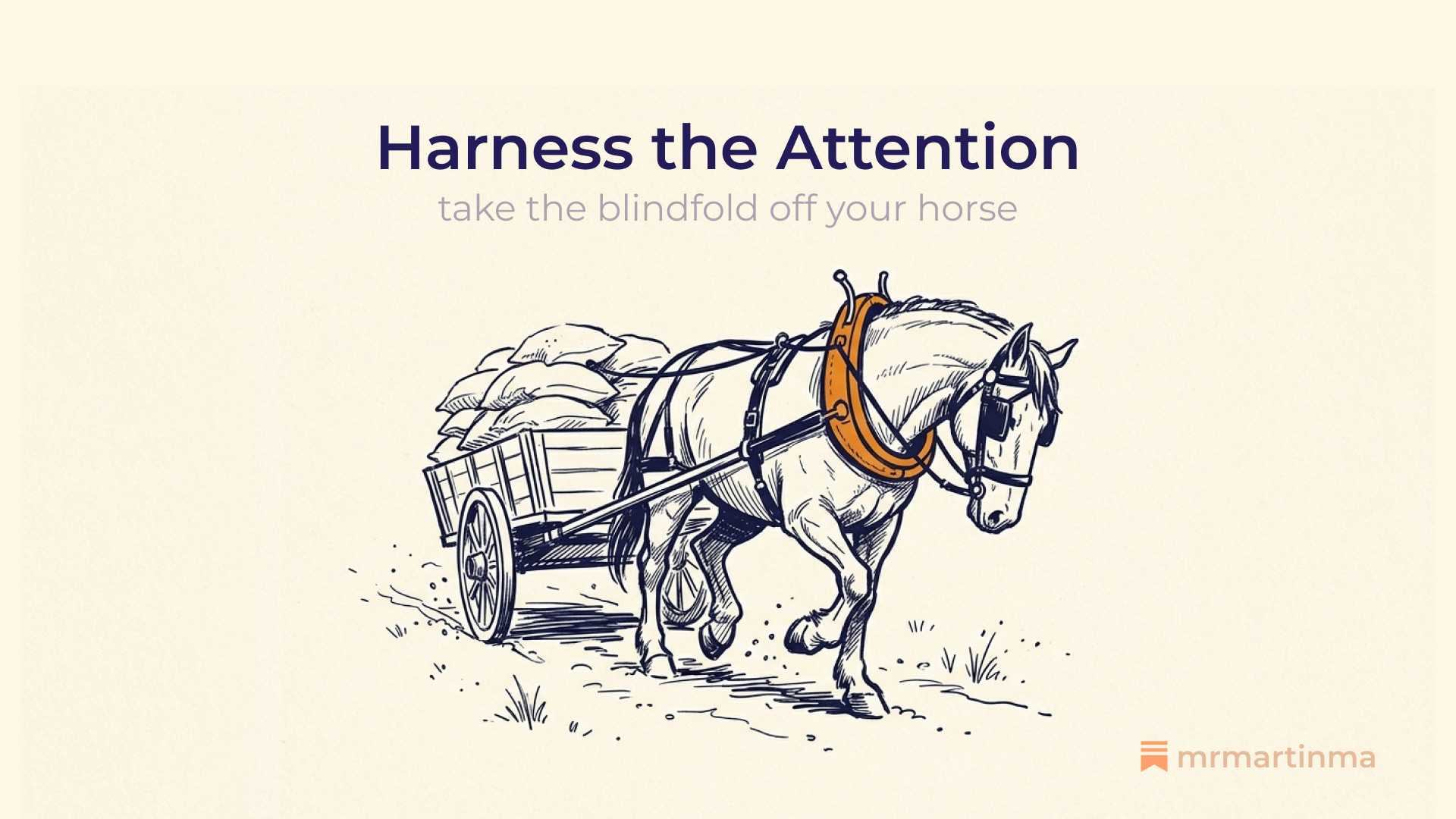
A harness doesn’t add an ounce of strength to a horse. It decides where the strength goes.
Fit it wrong and the horse spends its effort straining against its own throat. Fit it right and the same animal leans its shoulders into the load, and the cart finally moves.
In AI, the horse is the model. The harness is everything we’re all busy building around it: the memory, the tools, the services, the data and context layer, and the processes that tie them together. (If you’ve heard engineers talk about an “agent harness” lately, that’s the one.) Sometimes it matters more than the horse. The same model can score far lower in one harness than in another, with identical weights underneath.
Yet most of the energy still goes into shopping for a stronger horse. Every few months there’s a better model and a fresh round of “which one should we standardize on?” The strength is everywhere now. Anyone with a credit card can rent it, and a lot of it is still pulling against the throat.
What fills the harness.
A harness is only as good as what flows through it. The memory and the context layer both fill up from people using the thing.
That’s the attention I’d bet on, and I mean something narrow by that word: people choosing to come back because something changed for them. Impressions don’t count, and neither does the launch email with the great open rate. (The all-hands demo doesn’t count either, as much as we love a good all-hands demo.)
Last month I wrote that some products rent attention and call it a moat. This is the kind you can’t rent or buy. Every time people come back, the harness learns a little more about the load it’s meant to pull. For a company, that load is the business.
A beautifully built harness that nobody uses moves nothing.
Where the arrows land.
Lay out everything a company can put AI money into and you get a stack. I count twelve layers, running from the systems of record where the data lives, up through the models, the engine that runs the agents, the products people actually touch, and finally the program that decides what’s worth doing at all. Data, model, engine, product, program.
I’ve argued for every one of those. Data is super important, and so is the engine. I’d still take a program that organizes AI from the top down over a thousand bottom-up experiments nobody can see.
But each layer earns a different kind of attention. Data work earns the engineers’. The engine earns the builders’. The model earns the headlines, and the program earns the executives’. Only the product layers, the things customers and employees touch every day, earn the attention that compounds.
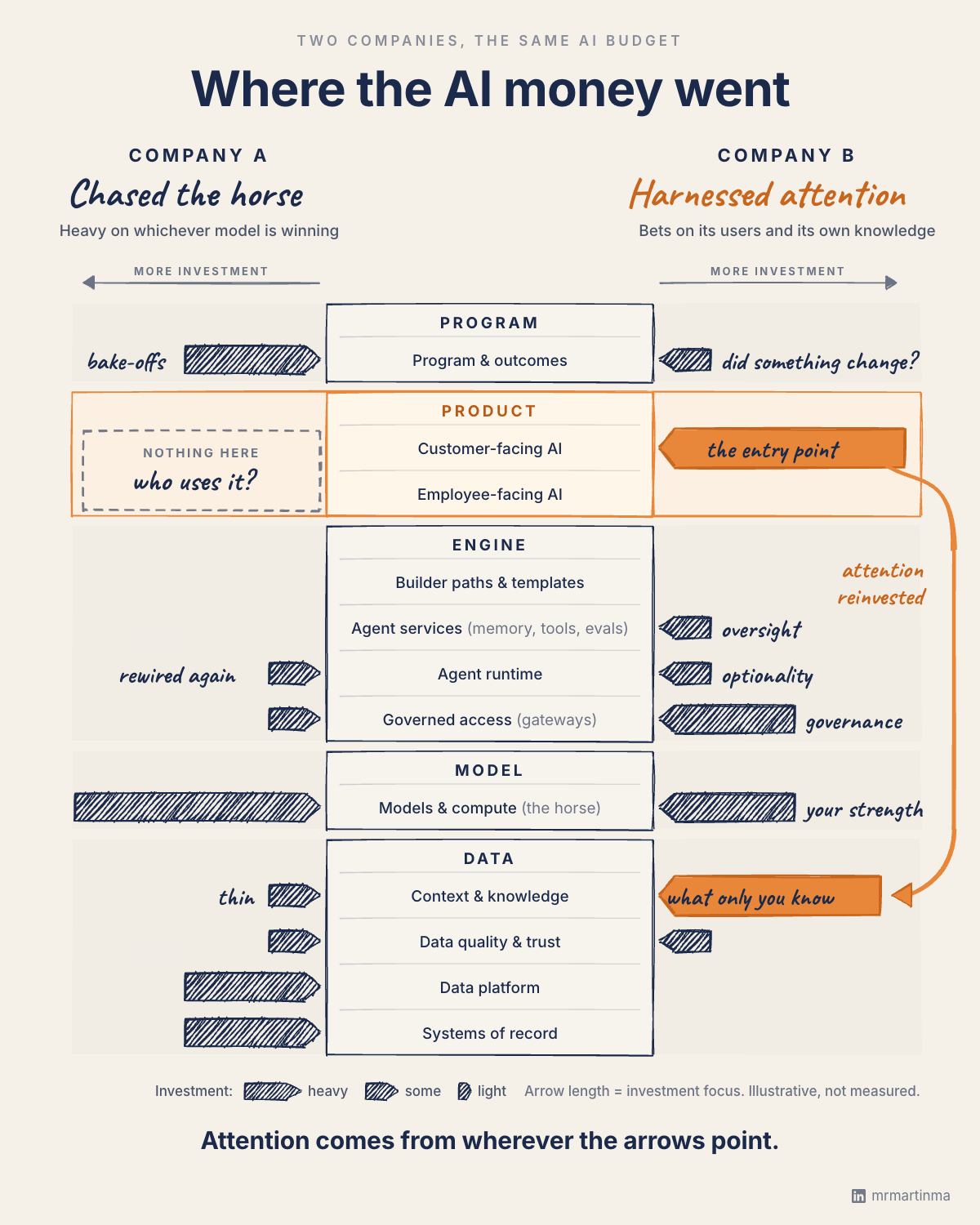
Read the picture the way an investor reads two portfolios. Company A pours its money into the horse: bake-offs, switching to whatever tops the leaderboard, more compute. Its context stays thin, and its product layers sit empty because nobody stopped to ask who would use them. Company B keeps its engine to governance and oversight, with room to swap parts as the models change, and builds its own context and institutional knowledge, with models shaped around them. Then it puts its biggest bet on one place people will feel, and whatever that earns flows back into what only it knows.
I understand why so much of the money chases the horse. It’s the part with a leaderboard. You can run a bake-off and announce a winner, and there’s always a new one next quarter. A product entry point means picking a real user and a real problem, and being visibly wrong if you picked badly. A model choice never has to stay wrong for long.
A lot of leaders are asking for AI’s ROI right now, and you can feel why. Most of them will tell you AI has made their teams faster. Far fewer can point to what it changed in the business.
What I used to believe.
I didn’t always see it in this order. In one of my first posts here, “In Data We Trust,” I called trust “the price of admission.” Earn trust first, then people give you their data, then you build something good.
Andrew Ng had written the opposite order down years before that. His advice for a company’s first AI projects was to pick the ones likely to succeed over the ones that would be most valuable, because “the important thing is to get the flywheel spinning.” He published that in 2018. I still wrote trust-first. (In my defense, it was a good sentence. It was just in the wrong place.)
The app I stopped using.
This month Meta ran the other order in public. It shipped Muse, a personal AI agent that runs errands for you and remembers what you told it. By Meta’s own scorecard, its model trails the frontier labs on the agent benchmarks. Ten days after launch it was the #1 app in the US App Store anyway.
Meta pointed the harness at the attention it already had, the apps billions of people open every day, and asked for everything else afterward: connect your email and calendar, then your bank.
It’s on my phone right now. I opened it, and the moment it asked me to connect another data source, I stopped. I know how these things work, and it wanted more of my data before it had changed anything for me. I’m not ready for that. It’s been downloaded more than three million times. Downloads aren’t attention by my own definition (I’m one of those downloads, and I haven’t been back), and it’s too early to know how many of the others come back. Every one who does makes it a little better for themselves. You don’t have to like the company to learn from where it pointed the harness.
My own harness.
The AI setup I trust most is the one that helps me write these posts, and it grew the same way.
It started as one post a week and a Friday deadline. Nearly every rule in it now arrived later, pulled in by a week when something went wrong. The checklist that flags anything that doesn’t sound like me is up to its fortieth check (the word “harness” is on it, which made titling this post a little awkward). The review lanes and the voice notes arrived like that too, because I kept coming back. Almost none of it was designed up front.
And it was built in the opposite order from how I’d have told a team to build one.
Where the [Attention] Flywheel Starts.
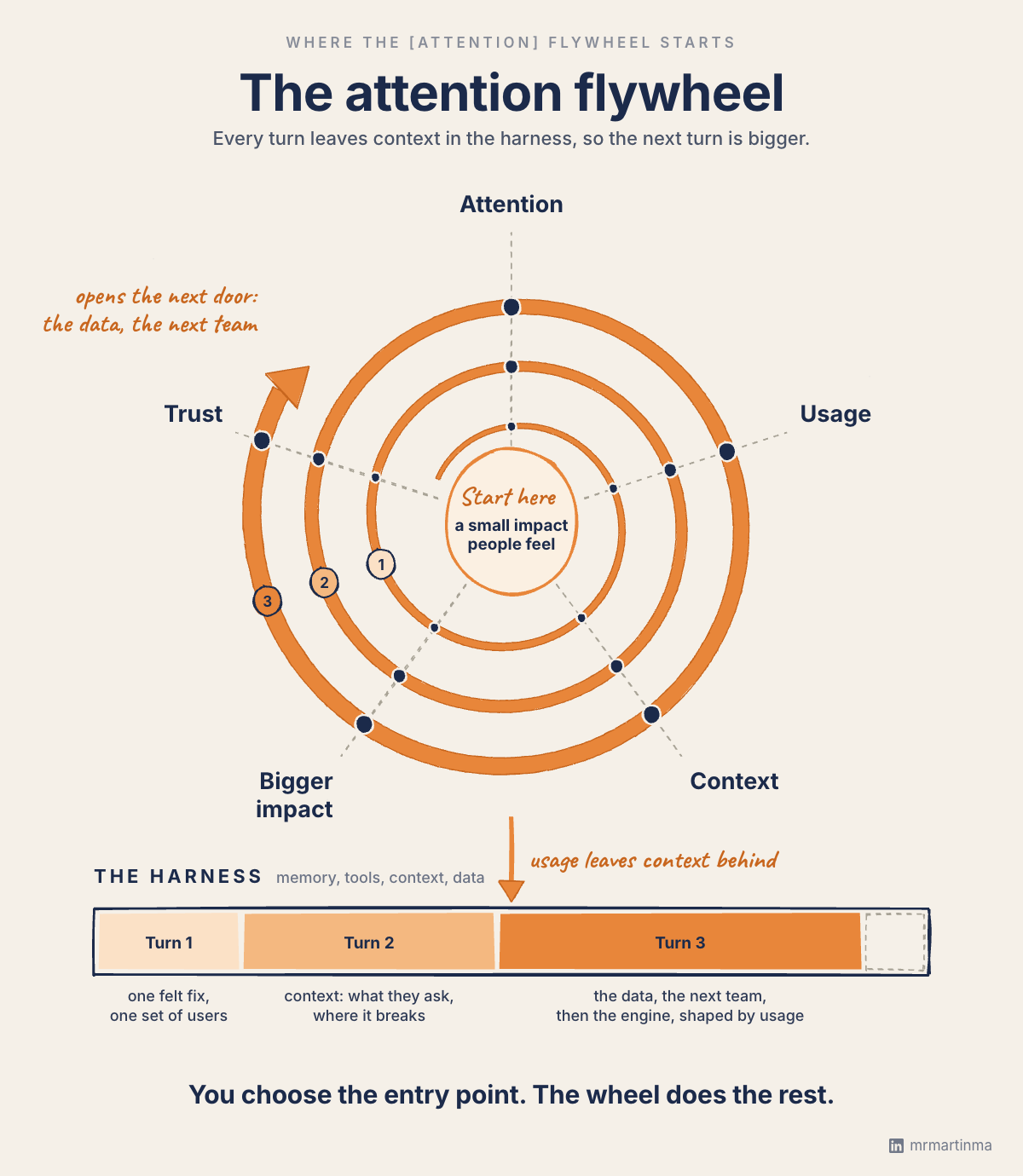
You pick the entry point: a small impact people will feel. That’s the only part you get to choose. The impact earns attention. Attention turns into usage. Usage leaves context behind (what people ask and where it breaks), and that context makes the next impact bigger. A bigger impact earns the trust that opens the next door, whether that’s the data you couldn’t get to or the team that wouldn’t take the meeting.
The rest of the harness still gets built. It just gets built later, in the shape the usage asks for, and paid for by the attention the entry point earned.
And the attention doesn’t wait for you. Your people are already using AI on their own, whether or not anyone bought them a seat. If your harness isn’t connected to your people’s attention, somebody else’s already is. This month, it might be Meta’s.
So before the next budget review, draw your own arrows. Find the layer with the most spend and the fewest people coming back. Move one arrow to a product entry point people will feel, inside the company or outside it. Keep the engine to governance and oversight, with your options open. Put your building where nobody can follow you, into the context and knowledge only you have. Let the attention the entry point earns pay for the rest. Then swap the ROI question for a harder one: what changed in the business, and whose attention did it earn?
You’ll get a stronger horse every quarter whether you ask for one or not. Be good enough to earn the attention. Then harness it.
Attention is all you need. (Yes, that one. Different attention.)
So, here is my question to you: if you drew your AI portfolio across those twelve layers, where would your arrows point?
#Leadership #AI #AIStrategy #ProductStrategy #FutureOfWork #AttentionIsAllYouNeed