

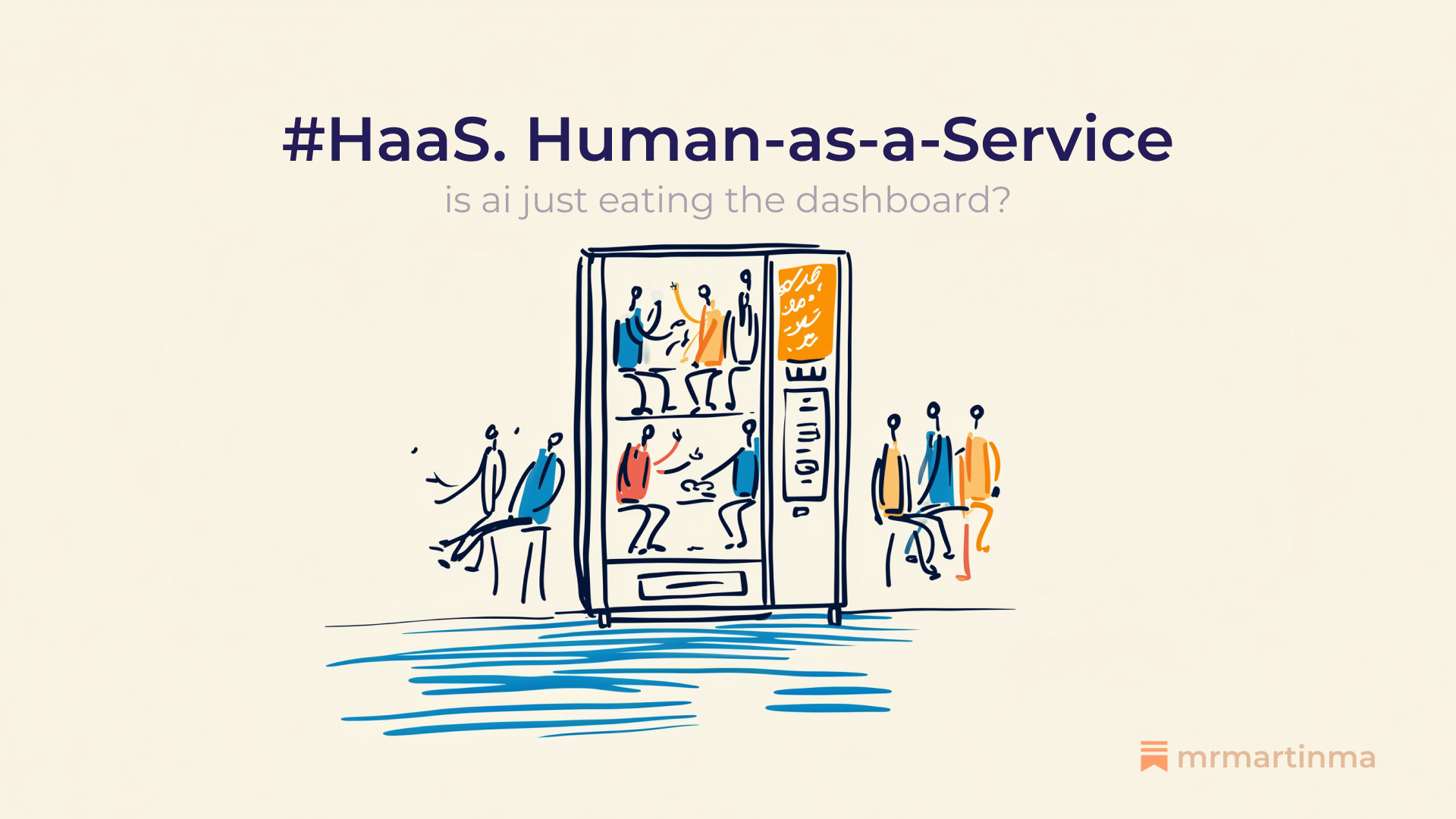
There’s a website called NeedHuman.ai. The homepage is written for machines.
You can submit a task to a human via API for five dollars. The median response time is eleven minutes. The customer is other AI agents.
If you haven’t seen it, open it now and read it three times. You’ll do what I did — check whether you’re on a parody site. It is a real product. Pre-v1.0. Forty-one tasks completed in the entire history of it.
NeedHuman is not the only one trying. HumanRail is in early access. Sub-five-minute response time, Lightning Network payouts, integrations with LangChain, CrewAI, OpenAI Assistants, Claude. Duckbill is older. A consumer concierge product (phone calls, errands, two hundred background-checked operators, three hundred forty thousand tasks across the years) now retrofitting itself for the agent buyer with an MCP-native developer API.
The category has a name. Human-as-a-Service. HaaS.
The products in it are all early. NeedHuman is a solo-founder experiment. HumanRail is in early access. Duckbill is a retrofit. The point isn’t that the market is mature. The point is that the protocol exists.
For twenty years we built infrastructure for humans to consume software. Someone is now shipping infrastructure for software to consume humans. The shape of the question changed.
The question nobody is putting on the slide
The reason this matters isn’t the products. It’s what the products are evidence of.
For most of the last decade, every dashboard, every BI tool, every Looker chart was infrastructure pointed in one direction. Machine-readable data, human reader. HaaS points the other way. Human-readable work, agent reader.
Both directions are real. Both are funded. Right now, this quarter, on every engineering roadmap, a question is being voted on that almost nobody is putting on the slide.
Are we building ...
Company A — a human-centric company with an AI assistant, where humans hold the decisions and AI is the unlimited team that drafts, cleans, summarizes, and serves?
Or are we building ...
Company B — an AI-centric company with a human, where the agent holds the decisions and the human is the judgment resource the agent pings when it needs us?
Both companies exist in the wild today. Both have receipts.
Company A
The mature version of Company A isn’t more dashboards. It’s better delivery of insight to where humans already are.
Per WisdomAI’s case study, a mortgage operations company called HomeStory Rewards retired ninety-five percent of their legacy BI dashboards earlier this year. They didn’t replace them with no dashboards. They replaced them with AI agents that pushed insights into Slack and email, where the analysts already lived. The dashboard moved from place I go to look into thing that pushes me what to look at. Two-week deployment. The humans still made the calls.
Shopify under Tobi Lütke calls it “AI-first, not AI-only”. Engineers must demonstrate why they need additional humans before adding headcount. But the company maintains what their playbook calls comprehension debt guardrails. Engineers are expected to understand the systems two to three layers below where they’re working. About twenty percent productivity gains, measured not in lines of code but in faster prototyping and higher-fidelity deliverables. The human is still in the seat.
That’s the pattern of a human-centric company with an AI assistant. The human is the executive. The AI is the unlimited team that drafts and serves. The dashboard mutates from artifact-to-look-at into delivery-channel-into-existing-work. The consumer of every metric is still a primate.
Company B
Then there’s the other company.
Pieter Levels is the existence proof at the indie end. Millions in annual recurring revenue, solo, zero employees. The flight simulator he built in three hours in February of last year was making one hundred thirty-eight thousand a month by November. There are no dashboards in his stack because there are no humans inside to read them. The cron jobs run, the Stripe charges land, the metric is the bank balance, the agents handle the rest.
NeedHuman, HumanRail, Duckbill are the infrastructure end of the same company. When an agent in a Company-B-shaped org hits a step it’s mechanically blocked on (a Terms-of-Service click, a CAPTCHA, a one-time account creation, an identity verification), it has somewhere to call. Eleven-minute median. Five dollars a task. The agent is the customer. The human, today, is mostly the founder of NeedHuman, at the other end of his own API. NeedHuman is half real product, half deadpan wink at the agent-economy bubble. Both halves are load-bearing, because nobody quite knows yet how serious any of this is, including the people building it. (Especially them.) The protocol shipped before the workforce did. The protocol is the bet that the workforce will arrive.
Klarna is the cautionary middle. Under Sebastian Siemiatkowski, it tried to push hard toward an AI-centric company in 2024. The AI agent did the work of eight hundred fifty human agents. Headcount dropped about fifty percent through attrition since 2022. By May of last year they walked it back. The framing they settled on was that AI-only produced lower-quality outcomes and forced expensive reversals. They tried it at scale. They retreated.
That’s the pattern of an AI-centric company with a human. The agent is the executive. The human is the on-call resource. The protocol exists before the supporting infrastructure does. Company B is real and shipping. It is not yet a free option for any org with quality SLAs.
The vote is already being cast
Here’s the part most leaders haven’t seen yet. This isn’t a hypothetical fork. The vote is already being cast on every roadmap.
85% of enterprises say they want to be an “agentic enterprise” within three years. 19% actually run multi-agent systems today, though adoption is accelerating. Gartner forecasts that more than 40% of agentic AI projects will be cancelled by the end of 2027 — not because the technology fails, but because of escalating costs, unclear business value, and inadequate risk controls.
On the same roadmap, in the same quarter, two budget lines vote opposite directions. Modernize the BI layer. Tableau Pulse, Microsoft Copilot in Fabric, Snowflake Cortex Analyst, Databricks AI/BI Genie. A vote for a human-centric company with an AI assistant. Better translation between machines and primates. Then wire MCP into the stack or build the semantic layer. A Cube benchmark earlier this year showed that four kilobytes of semantic context buys seventeen to twenty-three percentage points of accuracy on every frontier model, with the gain coming from context, not from a bigger model. A vote for an AI-centric company with a human. Preparing for a different consumer.
The honest read is that most companies are funding both. Talking about the second. Building the first. Assuming the disconnect will resolve itself. Gartner’s three reasons read like the autopsy of that disconnect. The discipline of choosing which tool gets used for what is the leverage that decides which side of the fork you actually fund.
Closing
Someone is making money off NeedHuman right now. Eleven minutes, five dollars, a founder at the other end. Somewhere else, a team that has never heard of NeedHuman is approving budget for a new BI tool because their current dashboards are getting stale.
Both companies are real. Your roadmap is voting for one of them this quarter, whether or not anyone in the building said so out loud. The fork is human-centric-with-an-AI-assistant, or AI-centric-with-a-human.
Which company is your roadmap quietly funding?
#Leadership #AI #FutureOfWork #EngineeringLeadership #HumansAsAPI